
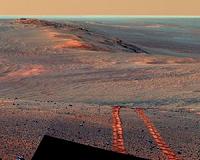
Opportunity is continuing the exploration of "Perseverance Valley" on the west rim of Endeavour Crater, pursuing several scientific hypotheses as to the origin of the valley.
The rover is positioned about halfway down the approximately 656 feet (200-meter) valley near an apparent flow stream island. Opportunity is finishing up some in-situ (contact) investigations of local outcrops. However, tabular rocks a few feet upslope have become of great interest to the science team.
On Sol 5053 (April 11, 2018), the rover completed the investigation of the target called, "Nazas" with a Microscopic Imager (MI) mosaic, followed by the placement of the Alpha Particle X-ray Spectrometer (APXS) for a multi-hour integration.
The next three sols, Opportunity performed targeted remote sensing with all 13 filters of the Panoramic Camera (Pancam) multispectral camera. With activities complete, the rover moved on Sol 5057 (April 15, 2018), backing up and turning just about 14.8 feet (4.5 meters) to set up the approach upslope to the tabular rocks.
The usual post-drive Navigation Camera (Navcam) panoramas were collected along with some targeted 13-filter Pancam images.
On the next sol, Opportunity tried to go upslope to the tabular rocks. However, the terrain was difficult and the rover experienced high slip. Just under 9.8 feet (3 meters) of motion was achieved. More post-drive documentary imagery was collected.
The assessment is that a different, less difficult route to the tabular rocks must be taken.
So, in future sols a more roundabout path to the rocks will be planned over multiple sols. Sol 5059 (April 17, 2018) was to be a remote sensing sol, but the Deep Space Network station's transmitter was flagged red (not operational) and our Sol 5059 (April 17, 2018) plan was never received.
Opportunity instead exercised the onboard run-out sol. Nominal planning will resume with Sol 5060 (April 18, 2018).
As of Sol 5058 (April 16, 2018), the solar array energy production was 726 watt-hours with an atmospheric opacity (Tau) of 0.558 and an improved solar array dust factor of 0.826.
Total odometry is 28.05 miles (45.14 kilometers).
