
SAU AstroChallenge employees are convinced that this new map of medium-scale travelling ionospheric disturbances will help find out the reasons of the emergence of such phenomena in midlatitude areas. MSTIDs have not yet been thoroughly studied. They significantly impact the distribution of radio signals, so appropriate research is of great practical importance.
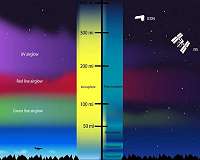
The paper, titled "Collocated ionosonde and dense GPS/GLONASS network measurements of midlatitude MSTIDs", covers the first ever complex analysis of MSTIDs obtained by two methods of radio sounding. MSTIDs, which are huge wave perturbations somewhat resembling aurora borealis, are invisible in midlatitude areas.
The ionosonde combined with a dense network of GPS/GLONASS receivers was able to detect the structure of MSTIDs in necessary conditions.
Ionosonde constructor, Associate Professor Adel Akchurin explains, "It's necessary to note that most of the coherent and incoherent scatter radars are insufficiently sensitive to detect
MSTIDs.
There is only one in Arecibo capable of doing that. However, it only allocates two days a year for these tasks. It was formerly hypothesized that all travelling ionospheric disturbances are caused by internal gravitational waves. We found out that only some part of MSTIDs don't contradict this theory, but others don't fit into it and warrant further research."
KFU employees now plan to put forth a new theory of MSTIDs which would take account of all factors influencing the ionosphere, including cosmic rays.
Military defense market faces new challenges to acquiring SatCom platforms
With high-throughput satellites covering 99% of the populated regions of the world, commercial satellite providers like Intelsat General are ready and willing to serve the growing bandwidth needs of the military defense market. But there's a catch. At the Global MilsatCom conference held earlier this month in London, new acquisition challenges came to light: Countries are still trying to figure … read more
