
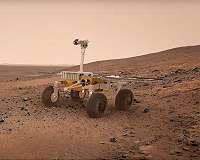
The new Mars rover planned for launch Thursday from Florida will kicks off an effort that takes least 10 years to bring rock samples back to Earth.
On board the Perseverance rover are 43 containers the size of cigar tubes, designed to hold rock and dirt samples. If all goes well, many of them will be back on Earth by 2031 as part of an international effort to study them for possible signs that life once existed on Mars.
If successful, the samples would be the first items ever returned from another planet. The plan to get them back involves several spacecraft, two rovers and the first attempt to launch a rocket from another planet.
"It's kind of an interplanetary relay race," David Parker, director of human and robotic exploration for the European Space Agency, said at a news conference Tuesday based at Kennedy Space Center. The agency is part of the international effort to bring samples back from the Red Planet.
"Any launch to Mars is exciting but to me, but this is exciting times 10 because of the sample return," Parker said.
"The samples from Mars have the potential for profound change of our understanding of Martian planetary evolution," said Thomas Zurbuchen, associate administrator of NASA's Science Mission Directorate.
Scientists have wanted for decades to obtain rock samples from Mars. A global panel of researchers decided in 2008 that a sample return would be "the single mission that would make the most progress" in understanding Martian geology and possible biology.
Experts have studied meteorites that landed on Earth and are known to be from Mars, but Perseverance offers the chance to choose Martian rocks specifically for their scientific value.
The rover, about the size of a small SUV, is packed with instruments that will examine rocks in the Jezero Crater just north of the Martian equator. Scientists believe water once flowed from a river into the crater, and that the area had potential to support life at one time.
Hundreds of scientists on Earth will study the data and images Perseverance beams back and decide precisely where to drill, according to Chris Herd, a scientist with the Canadian University of Alberta in Edmonton, who is part of the Mars sample return program.
The goal is "to collect at least 20, ideally more like 30 or 35 samples that not only have the potential to show evidence of ancient life, but to reflect a variety of different types of rocks," Herd said at Tuesday's press conference.
Finding rocks that formed in water is a key to discovering evidence of life because they could hold traces of organic compounds or even existing microbes, if any exist on Mars, he said.
Once scientists identify a rock of interest, Perseverance will drill into it and obtain a core sample about 2 inches long, according to NASA.
The robotic instruments on the rover will then seal the sample in a tube and place the tube in a storage rack on board. The rover will then transport the tub until mission control commands it to deposit the container on the Martian surface.
Perseverance, however, isn't equipped to send the samples back to Earth. That will be up to two spacecraft NASA and the European Space Agency plan to launch around 2026 — the NASA-led Sample Retrieval Lander and an ESA-led Earth Return Orbiter.
The lander is to include a fetch rover to retrieve the samples and bring them back to the lander, from which a small rocket would launch them into Mars orbit. The orbiter then would retrieve the samples and fly back to Earth.
NASA expects the samples to depart Mars in 2029 and return to Earth in 2031. The agency also plans to build a highly secure laboratory on Earth to contain and study the samples.
