
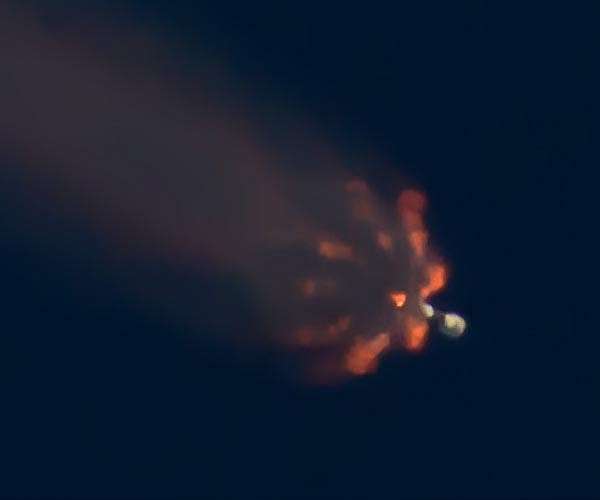
Maxar Technologies (NYSE:MAXR) (TSX:MAXR), provider of comprehensive space solutions and secure, precise, geospatial intelligence, has announced that Galaxy 31 and Galaxy 32, built for Intelsat, are performing as expected after being launched aboard a SpaceX Falcon 9 rocket from Cape Canaveral, Florida.
These two geostationary satellites will enable Intelsat, operator of the world's largest integrated satellite and terrestrial network and leading provider of inflight connectivity, to transfer its services-uninterrupted-as part of the U.S. Federal Communications Commission (FCC) plan to reallocate parts of the C-band spectrum for 5G terrestrial wireless services.
Galaxy 31 and Galaxy 32 are the first of five satellites that Intelsat contracted Maxar to build for the C-band transition. All five satellites will be built on Maxar's proven 1300-class platform, which offers the flexibility and power needed for a broad range of customer missions.
Shortly after launch, both satellites deployed their solar arrays and began receiving and sending signals. Next, Galaxy 31 and Galaxy 32 will begin firing thrusters to commerce their journeys to final geostationary orbit.
"This launch of Galaxy 31 and Galaxy 32 is another milestone in Maxar and Intelsat's decades-long relationship," said Chris Johnson, Maxar Senior Vice President and General Manager of Space. "Our team will begin initial on-orbit checkout and Intelsat will proceed with commissioning activities of these satellites so that Intelsat can start moving their services to the new spectrum."
"The Intelsat Galaxy fleet is the most reliable and efficient media content distribution system in North America, enabled by Maxar's engineering and manufacturing expertise," said David C. Wajsgras, Intelsat CEO. "This investment will deliver a high-performance technology path through the next decade."
Maxar also manufactured Intelsat's Galaxy 35 and Galaxy 36, which are preparing for launch in mid-December 2022.
