
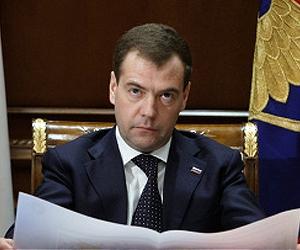
Russian President Dmitry Medvedev Wednesday hailed "strategic" ties with NATO-member Turkey as the two sides prepared to seal energy deals, including a plan to build Turkey's first nuclear power plant.
"Our relations have dramatically changed over the past years. Today they are strategic," Medvedev told a joint press conference with Turkish counterpart Abdullah Gul.
"This is a very special day in Turkish-Russian relations," he said after overseeing the signing of cooperation accords in the fields of combating drug-trafficking, transport and education.
Gul said the two countries were determined to triple bilateral trade in five years to 100 billion dollars, a goal Medvedev said was ambitious but within reach.
The crowning point of Medvedev's visit was to be a memorandum to build and operate a nuclear power station in Turkey, likely be signed after the first meeting of a "high-level cooperation council" co-chaired by the Russian leader and Turkish Prime Minister Recep Tayyip Erdogan.
Russia has long looked to build Turkey's first nuclear power plant, but a Turkish court last year scrapped a tender won by a Russian-led consortium to build four reactors with a total capacity of 4,800-megawatts at Akkuyu, on the Mediterranean coast.
Another highlight was a deal mutually lifting visas.
"This agreement is ready for signing," Medvedev said. "It is a historic and breakthrough agreement, which will be aimed at making life easier for millions of people."
Turkey's Mediterranean coast is a popular destination for Russian tourists.
Russia's gas giant Gazprom and state oil firm Rosneft will also ink contracts. Kremlin foreign policy adviser Sergei Prikhodko said they would be among the "most commercially significant" deals to be signed but no details were immediately given.
Another deal will involve a planned Turkish oil pipeline from the Black Sea port of Samsun to Ceyhan on the Mediterranean, aimed at reducing tanker traffic through the congested Bosphorus Strait.
Last year, Turkey secured a Russian pledge to supply oil for the Samsun-Ceyhan conduit in return for backing its South Stream pipeline project aimed at protecting Moscow's dominant share in the European gas market.
Russia wants to build a section of South Stream through Turkey's Black Sea waters in a new route to Europe bypassing Ukraine.
Turkey, which backs also the European Union's rival Nabucco pipeline, agreed in August to allow Russian surveys for the project in its portion of the Black Sea.
Despite sometimes shaky political ties, economic exchanges between the two countries have boomed since the fall of Communism: in 2009, their trade volume stood at 22.9 billion dollars, making Russia one of Turkey's top commercial partners.
Russia's military intervention in Georgia in 2008 briefly strained relations with Turkey, which has close economic and political ties with the former Soviet republic, its northeastern neighbour.
Russia is Turkey's main gas supplier, providing about 60 percent of Turkey's gas imports, and more than a million Russians boost Turkey's vital tourism sector each year.
Medvedev and Gul said they discussed Iran's controversial nuclear programme and efforts for stability in the Caucasus.
Both leaders stressed the Middle East should be free of nuclear weapons, while Medvedev pledged support for Turkey and Armenia's stalled efforts to normalize ties and overcome a history of enmity.
Russia is ready to help resolve a territorial conflict between Armenia and Azerbaijan that is the main obtacle to peace efforts between Ankara and Yerevan, Medvedev said.
Share This Article With Planet Earth
