
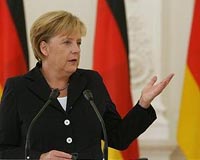
German Chancellor Angela Merkel told Russian President Vladimir Putin on Sunday that she considered the referendum being held in Crimea this month on joining Russia was "illegal".
"The chancellor asserted the German position forcefully that the so-called March 16 referendum on Crimea is illegal. It is against the Ukrainian constitution and international law," her spokesman Steffen Seibert said, recounting a phone call between the two leaders.
In a strongly-worded message, Merkel also said that she "deplored the lack of progress that has been made in forming an international contact group to help find a political path and a solution to resolve the conflict in Ukraine".
Seibert added that the German Chancellor had stressed the urgent need to find a result in this area.
Merkel also discussed the Ukraine situation during a telephone conversation with Chinese President Xi Jinping.
According to Seibert, Xi said he was favourable to finding a political solution "through dialogue".
"He emphasised that an end to the crisis should be based on international law," he said.
A statement released by Moscow after Merkel's conversation with Putin — and a subsequent conversation the Russian leader had with the British Prime Minister David Cameron — asserted the Kremlin's position that the pro-Russian forces in Crimea were "legitimate".
Putin wished in particular to stress that "the lawful leadership in Crimea is taking actions based on international law and with the aim of guaranteeing the legitimate interests of the population of the peninsula," Moscow said.
A referendum will be held in Crimea on March 16 to see if the southern Ukrainian region wants to immediately become part of the Russian Federation.
Ukraine's Tymoshenko in Berlin hospital
Berlin (AFP) March 08, 2014 –
Ukraine's former Prime Minister, Yulia Tymoshenko, has arrived in Berlin for medical treatment, a hospital official said Saturday.
The face of the pro-Western Orange Revolution in 2004, who suffers from herniated discs, started medical examinations on Saturday morning, said Karl-Max Einhaupl, director of the Charite University Hospital, Berlin.
No decision on whether she will need an operation has yet been taken, Einhaupl added.
"Tomorrow (Sunday) and Monday, we will continue our diagnosis to see what can be done," he said during a televised press conference.
He stressed that it was impossible to predict how long Tymoshenko will remain in care, stressing that the hernias caused her "severe pain".
"We have confidence that she will be able to walk freely again," he said.
Tymoshenko, 53, was freed from prison on February 23, having served three years of a seven year sentence for abuse of power, charges she always denied.
Immediately after her release, she appeared in a wheelchair in Kiev's Independence Square to address protestors in Ukraine's capital.
Tymoshenko's relationship with the Berlin hospital goes back several years.
A team of its doctors were given permission to examine her in April 2012 while she was imprisoned, although their recommendation to treat her in Germany was never accepted by Kiev.
Tymoshenko also met with German Chancellor Angela Merkel over the weekend on the sidelines of the European People's Party congress in Dublin.
