
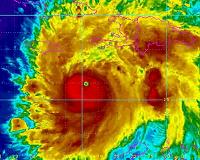
Some three million people on the US southeast coast faced urgent evacuation Thursday as monstrous Hurricane Matthew — now blamed for more than 100 deaths in Haiti alone — bore down for a direct hit on Florida.
Highways in Florida and neighboring states clogged up with people streaming inland to escape the storm blasting in from the Caribbean, as officials warned people tempted to ride it out they may be risking their lives.
President Barack Obama declared a federal state of emergency in Florida as it braced for the ferocious Category Four hurricane, expected to bring beach-eroding waves as tall as two-story buildings and winds strong enough to snap trees and blow away roofs or entire houses.
Poor and vulnerable Haiti remained essentially cut in half two days after Matthew hit. Interior Minister Francois Anick Joseph said at least 108 Haitians have died, with 50 killed in a single town and reports of "complete destruction" in the island's south.
In its latest target, the storm slammed the Bahamas Thursday, blowing off roofs, downing trees and knocking out power. Weather forecasters working out of Nassau airport had to flee for their lives.
According to the forecast track, the hurricane could make landfall in the United States near Cape Canaveral, where NASA's Kennedy Space Center is located, by Friday morning.
As US gas stations ran dry, frantic shoppers flocked to stores for essentials.
They snapped up batteries, transistor radios, bread, canned goods, bottled water, ice and pet food to gird for what Florida Governor Rick Scott warned would be a devastating, killer storm, with winds howling at up to 150 miles (240 kilometers) per hour.
"Evacuate, evacuate, evacuate," he told a news conference. "Time is running out."
The region's strongest storm in years, Matthew regained power as it swirled toward the US coast, upgraded a notch to Category Four Thursday by the National Hurricane Center on its 1-5 scale.
– 'Body bags' –
In Myrtle Beach, South Carolina, the normally bustling resort turned into a ghost town as tourists loaded up cars, cut short vacations and fled north.
"It was packed with people here yesterday and then we came today and it was like 'Oh my God there is nobody here,'" Kelly Allmendinger, a 26-year-old bartender whose family was one of only two left on the eerily deserted beach.
Despite the mass flight, officials warned a worrying number of people were not heeding the evacuation order.
"People do not seem to get it and are not leaving," Sheriff William D. Snyder from Martin County, Florida, told NBC News.
"I'm not saying this to be theatrical… I asked my captain of detectives if he had body bags, because if we get 140 mile-per-hour winds in mobile home parks, we are going to have fatalities."
The fire service in St Augustine, northern Florida, issued a video message on Facebook warning that damage to the city was expected to be "catastrophic" and urging all holdouts to leave.
"We as a city are evacuating," said Fire Chief Carlos Aviles. "I cannot emphasize enough: we are encouraging you to leave."
"If you are choosing to stay in St Augustine, you are choosing to do so at your own risk. There will be no public safety personnel to assist you."
– 18-foot waves –
Some 1.5 million coastal dwellers are under an evacuation order in Florida alone. More than a million others in South Carolina and other coastal states were also told to escape the path of the storm, which first made landfall in Haiti Tuesday.
Mandatory evacuations were also ordered in six coastal counties in Georgia that are home to some 520,000 people.
Some 6,000 US Marine recruits were evacuated from a base at Parris Island, South Carolina.
Miami International Airport canceled 90 percent of its incoming and outgoing flights on Thursday and Walt Disney World — in Orlando, 35 miles inland from the Atlantic — was to close early on Thursday and stay shut Friday.
President Obama's emergency decree frees up resources to help Florida and authorizes the federal government to coordinate relief efforts.
Obama spoke with the governors of Florida, Georgia, North Carolina and South Carolina, pledging to provide them with all necessary federal resources to cope with the storm.
Both presidential candidates sent out messages of support to those affected, with Republican Donald Trump saying "Please stay safe" while Democrat Hillary Clinton urged people to heed evacuation orders, tweeting: "Stay safe Florida."
The National Hurricane Center said waves whipped up by the hurricane could reach as high as 18 feet (5.5 meters) — nearly as tall as a two-story building. Debris tossed into the air will be capable of blasting through buildings and cars, the NHC said in a bulletin.
Scott said the forecast is for storm surges of five to nine feet (1.5 to 2.7 meters), not counting the waves on top of that.
Power outages, possibly lengthy, are a near certainty.
– 'Running out of food' –
As Matthew barreled northwest, Caribbean nations continued the grim task of assessing damage and fatalities, with four dead in the Dominican Republic in addition to the surging toll in Haiti.
In Cuba, where some 1.3 million people were evacuated, there were no reported fatalities, but four cities in the east were cut off because roads were blocked by large chunks of rock hurled by the storm.
Haiti postponed a presidential election scheduled for Sunday as it reels from the strongest storm to make landfall there in half-a-century.
In one southern department alone, 29,000 homes were destroyed, the interior minister said.
In Haiti's southern city of Jeremie, "about 80 percent of the buildings are gone," tweeted Jean-Michel Vigreux, country director for the CARE relief agency. "All phone lines and electricity are gone. Access is completely cut off, and everyone is running out of food and money."
Further south in Les Cayes — home to a major port — an AFP reporter found the cathedral's roof completely blown off.
The town of Roche-a-Bateau, where at least 50 died, was also devastated, local lawmaker Ostin Pierre-Louis told AFP. "No one's house is left standing."
Deadly hurricanes in the Americas
Washington (AFP) Oct 6, 2016 –
Monstrous Hurricane Matthew, which was bound for the US state of Florida on Thursday after killing more than 100 people in Haiti, is the latest mega-storm to hit the Americas.
Some precedents in the region over the past two decades:
2013, Mexico: Manuel and Ingrid
In mid-September, the storms Manuel on the Pacific coast and Ingrid, on the Atlantic side of the Gulf of Mexico cause torrential rains ravaging 22 of the 32 Mexican states. At least 157 dead and 1.7 million left homeless.
2012, United States: Sandy
On October 29, Hurricane Sandy slams into the US state of New Jersey before rolling up through New York City, bringing hurricane-force winds to the densely populated region. It leaves around 200 dead, including around 40 in New York and leaves massive flooding and ruined infrastructure in its wake. Before hitting the United States it had lashed the Caribbean, with 54 killed in Haiti and 11 in Cuba.
2008, Haiti: Hanna
On September 3, Hurricane Hanna hits the island, leaving at least 500 dead. The successive passage of the storms Fay, Gustav, Hanna and Ike leave 1,100 dead and missing in the space of a month.
2005, United States: Katrina
More than 1,800 people are killed across the US Gulf Coast on August 29-30, when Hurricane Katrina makes landfall. A million people are displaced and the financial toll tops $150 billion.
2004, Haiti: Jeanne
Flooding caused by Hurricane Jeanne on September 17-19 kills more than 3,000, and leaves 300,000 homeless.
1998, Central America: Mitch
Between October 26 and November 5, Hurricane Mitch kills more than 9,000 people, leaves as many missing and 2.5 million homeless, mainly in Honduras and Nicaragua, two of Latin America's poorest nations. It is accompanied by the eruption of a volcano northwest of Managua.
