
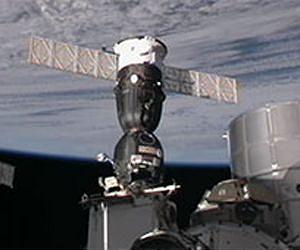
The Russian Federal Space Agency (Roscosmos) and NASA have reached preliminary agreements on delivering foreign astronauts to the International Space Station (ISS) on board Russian Soyuz spacecraft after 2016, chief of Roscosmos's manned spaceflight programs Alexei Krasnov said.
"The existing contract envisions the use of Russian Soyuzes for delivering astronauts to the ISS in the period up to 2017, but a Roscosmos delegation reached an agreement with NASA on extending the agreement to the end of 2017. Foreign astronauts will fly along with Russian cosmonauts on board our Soyuzes in 2017 and slightly longer," Krasnov said.
NASA expects that commercial manned spacecraft will carry out one or two test flights to the ISS at the end of 2017, Krasnov said. However, before the completion of the entire set of safety tests, these spacecraft would not be used to send people into space, and NASA will use Russian Soyuzes for this purpose, he said.
Russia's new ISS module to return to producer for adjustments
A Russian multirole laboratory module intended for the International Space Station (ISS) will be sent back to its manufacturer within the next few days after a decision was made to reschedule its launch for 2015 as the earliest because of the litter found in its pipes, Alexei Krasnov, director of the Federal Space Agency's (Roscosmos) manned space programs, said.
"This module is supposed to be delivered to the Khrunichev Space Center in December. I believe that it will leave the Energia Space and Rocket Corporation over the weekend and will arrive at the Khrunichev center next week," he said
Russia is global leader in space launches – Russia's Space Agency
Russia remains the global leader in the number of space launches, Head of Russia's Space Agency Oleg Ostapenko told the Federation Council on Thursday.
"Having cut in 2012-2013 its own launch programs, Russia still remained the world's leader in launches," he said. "The leading pad is, like it was in the past, the Baikonur cosmodrome."
"The Russian Federation observes fully its obligations on the transport services for the International Space Station by Russian Soyuz and Progress-M piloted spaceships," Ostapenko said.
Source: Voice of Russia
