
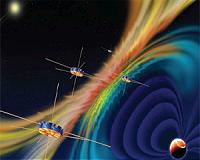
Scheduled to lift off on March 12, 2015, NASA's new Magnetospheric Multiscale, or MMS, mission consists of four identical spacecraft that each carry 25 sensors with unprecedented observational speeds. All that power will be essential to gather the first ever, three-dimensional measurements of a little understood phenomena in space called magnetic reconnection.
Magnetic reconnection happens when magnetic field lines realign quickly and explosively, initiating the movement of large-scale flows of particles, and accelerating particles up to nearly the speed of light. This is one of the most dramatic occurrences in space, powering gigantic explosions on our closest star such as solar flares, and causing particles to funnel into near-Earth space leading to aurora.
MMS will fly through magnetic regions near Earth, speeding through them in under a second, so the sensors must gather measurements amazingly fast. One of the speediest instruments is the Fast Plasma Investigation, or FPI, which was built at NASA's Goddard Space Flight Center in Greenbelt, Maryland. FPI will gather a full sky map of data some 30 times per second –100 times faster than any previous similar instrument.
FPI's job is to measure the charged particles, or plasma, present in magnetic reconnection sites. The FPI experiment has four detectors on each MMS spacecraft to measure electrons and four to measure ions. Each detector is, in turn, made of two sensors that can scan through a 45-degree arc for a larger panorama. Each pair of ion sensors can produce a three-dimensional picture of the ion plasma every 150 milliseconds; each pair of electron sensors do the same for the electrons every 30 milliseconds.
Not only is that an improvement of 100 times over previous plasma data collection, it's a jump in terms of instrument building. There are eight instruments plus one data processing unit on each of four spacecraft, which equates to 32 sensors and 4 data processing units, 36 boxes total.
"That's a huge number," said Craig Pollock, the Co-Investigator for FPI at Goddard. "We're used to delivering one instrument, or occasionally two or three."
It took four years to complete, but all the parts of FPI are complete and installed. MMS is ready to launch, and soon we'll be able to see just what kind of observations these super speedy sensors will provide.
MMS is the fourth NASA Solar Terrestrial Probes Program mission. Goddard built, integrated, and tested the four MMS spacecraft and is responsible for overall mission management and mission operations. The Southwest Research Institute in San Antonio, Texas, leads the Instrument Suite Science Team. Science operations planning and instrument command sequence development will be performed at the MMS Science Operations Center at the University of Colorado's Laboratory for Atmospheric and Space Physics in Boulder. ?
