
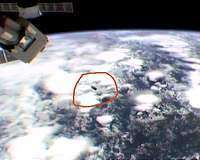
After a two-month stay aboard the International Space Station, NASA's Technology Educational Satellite (TechEdSat-5) that launched Dec. 9, 2016, was deployed on March 6, 2017 from the NanoRacks platform and into low-Earth orbit to demonstrate a critical technology that may allow safe return of science payloads to Earth from space.
Orbiting about 250 miles above Earth, the Exo-Brake, a tension-based, flexible braking device resembling a cross-shaped parachute, opens from the rear of the small satellite to increase the drag.
This de-orbit device tests a hybrid system of mechanical struts and flexible cord with a control system that warps the Exo-Brake. This allows engineers to guide the spacecraft to a desired entry point without the use of fuel, enabling accurate landing for future payload return missions.
Two additional technologies will be demonstrated on TechEdSat-5. These include the 'Cricket' Wireless Sensor Module, which provides a unique wireless network for multiple wireless sensors, providing real time data for TechEdSat-5.
The project team seeks to develop building blocks for larger scale systems that might enable future small or nanosatellite missions to reach the surface of Mars and other planetary bodies in the solar system.
CXBN-2 CubeSat to Embark on an Important X-ray Astronomy Mission
A university-built small satellite known as the Cosmic X-Ray Background NanoSat-2 (CXBN-2) is being prepared for its upcoming ambitious science mission. The spacecraft – scheduled for launch into space on March 19 – is expected to deliver crucial data that could advance our knowledge about the cosmic X-ray background (CXB). Led by Morehead State University (MSU), the CXBN-2 project addresses fun … read more
