
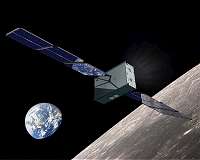
Nine university teams will collaborate with NASA to advance small spacecraft technologies that will help pave the way for human and robotic lunar exploration. Under NASA's Artemis program the agency plans to return humans to the Moon by 2024; small spacecraft, or "SmallSats," will help blaze the trail.
Currently, small spacecraft – ranging in size anywhere between a shoebox up to that of a refrigerator – mainly operate in low-Earth orbit. Technology advancements, through these collaborative partnerships, will more fully realize the potential of SmallSats as they extend their capabilities to complex lunar exploration missions.
"As we prepare for the next robotic and crewed missions to the Moon, we expect small spacecraft to help forge the path ahead by scouting terrain, prospecting for resources and establishing communications and navigation capabilities in cislunar space," said Christopher Baker, program executive for the Small Spacecraft Technology program.
"Taking advantage of their small size and shorter development timelines, small spacecraft are increasingly capable as both rapid precursor missions and as cost-effective, in-space infrastructure."
In the future, SmallSats could provide exploration missions with communications relays or navigation services at the Moon, similar to how we use communications satellites and GPS around Earth. This capability could play an important role in helping the agency build a sustainable presence on the Moon.
NASA's Small Spacecraft Technology program selected the university teams for its SmallSat Technology Partnerships initiative to mature new systems and capabilities. The technology development projects focus on three technical areas related to needs of Moon-bound missions:
+ Use of small spacecraft to help provide lunar communications and navigation services
+ Small spacecraft propulsion for lunar missions and potential return of lunar samples using small spacecraft
+ Small spacecraft electrical power and thermal management systems tailored for the distant and harsh environment between Earth and the Moon
The university teams and partner NASA centers, by topic, are available here
