
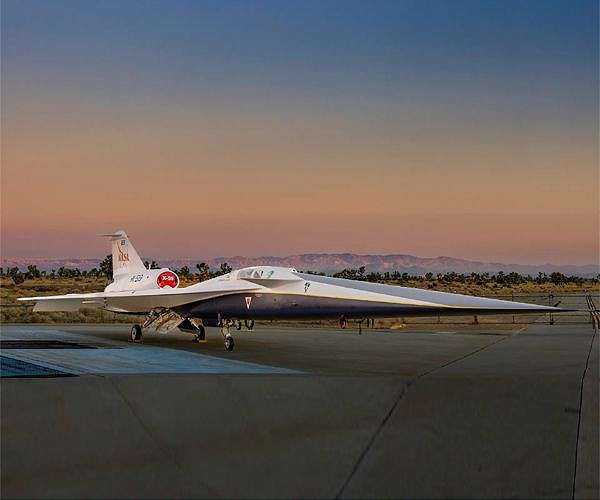
NASA's groundbreaking X-59 experimental aircraft, designed to fly faster than the speed of sound while producing a significantly quieter sonic boom, is inching closer to its ambitious goal, thanks to recent advancements in ground recording technology. The agency's Carpet Determination In Entirety Measurements (CarpetDIEM) project has completed pivotal tests to capture these quieter sonic "thumps" from the ground, marking a crucial step toward revolutionizing supersonic flight.
Over a 30-mile stretch of desert near NASA's Armstrong Flight Research Center in Edwards, California, researchers successfully set up 10 microphone stations as part of CarpetDIEM flights. These tests were focused on assessing the deployment, operation, and data collection capabilities of a new generation of ground recording systems, essential for the upcoming tests of the X-59.
"Forrest Carpenter, principal investigator for CarpetDIEM III, shared insights into the logistical challenges and learning curve associated with these tests. "We're kind of learning how to dance now so that when we get to the big dance, we're ready to go," Carpenter explained. This preparation is in anticipation of the X-59's eventual flights, designed to produce sonic thumps as quiet as about 75 perceived loudness decibels-a stark contrast to the over 100 decibels associated with the Concorde.
The CarpetDIEM III testing utilized F-15 and F-18 jets from NASA Armstrong to simulate the X-59's quiet sonic boom through 20 supersonic passes, with one maneuver achieving a noise level as low as 67 perceived level decibels. These efforts are instrumental in validating the X-59's innovative design, aimed at mitigating the disruptive sonic boom that has historically limited supersonic travel over land.
Larry Cliatt, sub-project manager for the QueSST acoustic validation phase, emphasized the importance of this technology for future aviation. "That is a lot quieter than the Concord," he noted, highlighting the X-59's potential to redefine the boundaries of supersonic flight with minimal noise impact.
The ground recording systems, calibrated to capture sounds as low as about 50 perceived loudness decibels, utilize Automatic Dependent Surveillance-Broadcast technology to trigger recording. This automation is vital for efficiently managing the extensive network of recording stations, designed to withstand the harsh desert conditions and potential wildlife interference.
Looking ahead, NASA anticipates a long-term deployment of these recording systems, up to nine months, during Phase 2 of the QueSST mission. The lessons learned from the CarpetDIEM flights, including the reduced setup time for recording stations and the coordination with various agencies, will inform the preparation for this next critical phase.
