
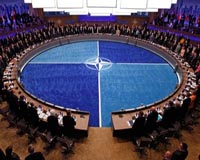
NATO defence ministers agreed Thursday the military alliance must now begin planning for a complete withdrawal from Afghanistan this year despite wanting to maintain a troop presence there.
With Afghan President Hamid Karzai refusing to sign a security pact with Washington to allow US troops to stay after 2014, there was no prospect NATO could reach such an accord either, alliance head Anders Fogh Rasmussen said.
"Without the necessary legal framework, there simply cannot be a deployment after 2014," Rasmussen said.
"So today, we agreed the need to plan for all possible outcomes. Including the possibility that we may not be able to deploy to Afghanistan after 2014, due to the persistent delays we have seen," he said.
Rasmussen said for NATO, this "is not the outcome we want. It is not the outcome that we think is in the interest of the Afghan people.
"However, it might be the unfortunate outcome if there is no security agreement in due time. This is what is at stake."
Earlier this week, US President Barack Obama talked by phone to Karzai over his repeated refusal to sign the Bilateral Security Agreement with Washington.
The BSA lays deal the legal basis for a continued US and NATO troop presence in the form of a training mission post-2014.
It is expected to number up to 12,000 troops, mostly American, and is seen as an important guarantee of continued US and NATO support during a difficult transition period.
In 2011, Washington withdrew all its forces from Iraq in a 'zero option' when it could not secure an agreement with Baghdad and there are fears a similar outcome in Afghanistan could leave the way clear for the Taliban to return to power.
US exit from Afghanistan could bolster Qaeda: commander
Washington (AFP) Feb 27, 2014 –
Al-Qaeda's core leadership in Pakistan has been seriously weakened, but the potential withdrawal of all US forces from Afghanistan could trigger a resurgence of the terror network, a top US commander said Thursday.
The warning came from the head of special operations command, Admiral William McRaven, known for overseeing the 2011 raid by Navy SEAL commandos that killed Al-Qaeda founder Osama bin Laden in his Pakistani compound.
"If we do go to zero, and there is no special operations component left in Afghanistan, it will certainly make it more difficult to be able to deal with the threat, …and the potential resurgence of Al-Qaeda in the area," McRaven told the House Armed Services Committee.
He said the danger posed by Al-Qaeda is "inherent within the federally administered tribal areas (in Pakistan), and in the northern part of Afghanistan, in Kunar and Nuristan (provinces)."
While most US-led forces are withdrawing from Afghanistan by the end of the year, Washington favors leaving a small force of up to 10,000 to train Afghan troops and counter Al-Qaeda in the region.
But Afghan President Hamid Karzai has so far refused to sign a bilateral security agreement that sets the legal framework for NATO troops to stay.
The Pentagon has begun planning for a full withdrawal, while US officials hope that a new president due to be elected in an April vote may be more willing to sign the security deal.
US officials privately acknowledge that retaining a military presence in eastern Afghanistan is vital for the continued use of air bases and intelligence operations needed for drone attacks against terror suspects in Pakistan's tribal belt.
Assessing the threat posed by Al-Qaeda, McRaven told lawmakers that the group's core "has gotten markedly weaker" while affiliate groups are surging in Yemen, North Africa, Iraq and Syria.
"So the threat is metastasizing. It is much more broad," he said.
But he said the danger presented by Al-Qaeda to the US "homeland" was less than it was five or ten years ago, with "one or two exceptions."
