
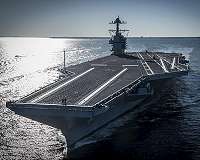
The Navy has confirmed that it will name the fourth Ford-class aircraft carrier in honor of Doris Miller, the first black man to receive a Navy Cross for his actions during the 1941 Pearl Harbor attack.
The Honolulu Star-Advertiser broke the news Friday that the branch was expected to announce the vessel's name at a Monday ceremony in honor of Martin Luther King, Jr. Day, and U.S. Naval Institute News confirmed the announcement Saturday morning.
On the morning of the Pearl Harbor attack Miller, a third-class mess attendant, was collecting laundry when an alarm sounded, so he manned a machine gun on the USS West Virginia to fire at attacking Japanese planes.
"It wasn't hard. I just pulled the trigger and she worked fine," Miller recalled after the battle.
After that he assisted the battleships' commander and several others in evacuating the ship before it sank.
In 1942 Fleet Adm. Chester Nimitz awarded Miller with the Navy Cross on the deck of the USS Enterprise. He continued to serve until 1943 when he was killed by a Japanese torpedo attack on escort carrier USS Liscome Bay.
At the time, African-Americans were not allowed to man guns in the U.S. Navy and as far as rank was concerned, Miller "could not really get above a messman level," according to Doreen Ravenscroft, president of Cultural Arts of Waco (Texas) and team leader for the Doris Miller Memorial.
"Without him really knowing, he actually was a part of the civil rights movement because he changed the thinking in the Navy," Ravenscroft said.
The new carrier is scheduled to replace the USS Carl Vinson, the USS John F. Kennedy and the USS Enterprise.
The retired Knox-class destroyer USS Miller was also named in honor of Miller.
Acting Navy Secretary Thomas B. Modly is expected to attend the Monday ceremony at Pearl Harbor to announce the carrier's name, as are two of Miller's nieces.
USS Gerald R. Ford carrier begins aircraft compatibility testing
Washington DC (UPI) Jan 17, 2020 –
The USS Gerald R. Ford left port in Norfolk, Va., to begin aircraft compatibility testing off the East Coast, the Navy announced.
The ACT, which started Thursday, is meant to continue testing of systems for aircraft to launch and land on the vessel. It started in earnest, the Navy said in a press release, with an E-2D as the first aircraft to land on the carrier as it departed from port.
The Ford, which is intended to replace Nimitz-class carriers but has been troubled by cost overruns and delays, last flew aircraft in January 2018 and has logged 747 launches and arrestments to date.
"This is one of the reasons why I love the Navy," said Airman Xavier Pettway, from Jacksonville, Fla. "It's crazy to think about. Even when we were doing drills on the flight deck my heart was beating so fast, and now, we're doing it for real. It's unreal, but I'm ready for it."
This will be the first time the T-45 Goshawks, E-2D Advanced Hawkeyes and E/A-18G Growlers aircraft will launch and recover from the aircraft carrier.
The upcoming phase of testing will also include launch-and-arrestment runs with F/A-18 E/F Super Hornets and C-2A Greyhounds.
"Ford is now proving all of the test-work accomplished at Joint Base McGuire-Dix-Lakehurst, N.J. over the last year-and-a-half, that we can fly fleet aircraft as a ship with EMALS and AAG integrated," said Cmdr. Mehdi Akacem, Ford's Air Boss. "This is very exciting, and it is the culmination of a year-and-a-half of training, anticipation, and teamwork."
This round of testing will allow the crew to test improvements made during post-shakedown availability at Huntington Ingalls Industries in Newport News.
It will allow the crew to continue testing the Electromagnetic Aircraft Launch System and Advanced Arresting Gear, the launch system of choice for the Ford and all future Ford-class carriers.
It uses stored kinetic energy and solid-state electrical power conversion, permitting a high degree of computer control, monitoring and automation.
In December, Huntingon Ingalls won an $11.5 million contract to repair the Ford, including its 11 electromagnetic elevators, just seven of which were operational at the end of October.
In 2019, the vessel completed a training evolution, sea trials and an independent steaming exercise that included sailing 7,000 nautical miles.
