
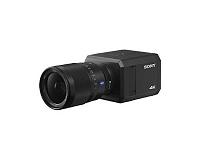
The capabilities of rapidly developing 4K video technology are turning night into day, and claiming a place once ruled by only by infrared and night vision equipment. Engineers at Sony think they have reinvented a new night owl.
In many respects, Japan is the granddaddy of cutting-edge video development. Lavishly subsidized by the state since Tokyo hosted the Tokyo Summer Olympics in 1964, Japan's "Hi-Vision" specifications finally received the blessing of the International Telecommunications Union (ITU) as the global studio standard in 2000. Since then, high-definition TV (HDTV), the commercial equivalent of Hi-Vision, rapidly became the broadcast standard in most developed countries.
While the upgrade over prior media tech was truly revolutionary, evolution continues apace. Following an explosion in the market for HDTV-quality video equipment over the last 20 years, steady price falls have allowed 4K ultra high-definition (UHD) technology to make serious inroads in television and consumer media from 2015.
The difference between HD and UHD is significant on many levels; for the viewer, 4K UHD's 4320p quality contains over 8 million pixels versus just over 2 million pixels for standard HD 1080p resolution, resulting in unprecedented clarity. UHD's 16"9 aspect ratio (the same format seen in movie theaters) remains the same as HDTV.
"It will take some time before UHD broadcast quality takes root as the norm," says Sony sales engineering manager Koichi Tamura, present at Sony's display booth during Security Show 2016, an exposition held at Tokyo Big Sight in Odaiba from March 8 to 11.
"Still, for people into video recording and filmmaking, the graduation to UHD represents another quantum leap. Security and surveillance geeks, especially, want to be on the cutting edge."
Sony's newest, hottest commercial UHD camera is the squarish, black, innocuous-looking 700g SNC-VB770 network surveillance unit. Equipped with a 35mm full-frame CMOS sensor, it can take both 4K video and 12.2-megapixel color photos amid light as faint as 0.004 lux (a moonless clear night sky registers at .0002 lux).
Sony's 'E-mount' architecture maximizes the performance of the sensor, keeping resolution high across the entire image area. The camera also allows for a good deal of customization and flexibility, as Sony grants permission to third-party manufacturers to create lenses without having to pay royalties.
Since 2011, Sigma, Zeiss, Voigtlander, Rokinon, Zunow, Tamron and others have crafted new lenses that can be used with Sony's machine. Earlier this year, Sony also launched its own G Master brand of interchangeable lenses.
Other features include 'intelligent cropping,' which lets users crop images in 4K resolution from multiple images at the same time with simultaneous video streams. In dynamic mode, the camera can detect and track moving objects automatically. The camera's 'intelligent scene capture' feature also allows for automatic adjustments and adaptations in picture quality depending on time, weather and lighting conditions.
"Upgrading to 4K UHD can pose memory capacity problems due to the high pixel density, so the cropping function can save a great deal of disc space, and let the camera to focus on only what matters to the operator," says Mr. Tamura.
In a dark viewing room at the expo, Sony's UHD camera generates screen images imperceptible to the naked human eye, turning a near-pitch black moonless nature scene into clearly identifiable terrain in full color-reminiscent of professional, perhaps even military-grade night-vision equipment. Meanwhile, a competing HDTV screen of the same scene remains nearly completely dark.
"Anyone who's ever used even an infrared camera to see in the dark knows that even that technology can be unreliable. However, (Sony's) new surveillance camera…takes night vision to a whole new level," says tech review site Videomaker.
The SNC-VB770 is fully networkable, outfitted with connectivity for Wi-Fi, LAN, HDMI port, audio input, sensor input, and alarm output. Plans call for commercial availability from August at a price of about $7,500. The quality of the unit's imagery-thanks to Sony's world-class lead in sensor technology–should offer significant value over rival makers, adds Mr. Tamura.
