
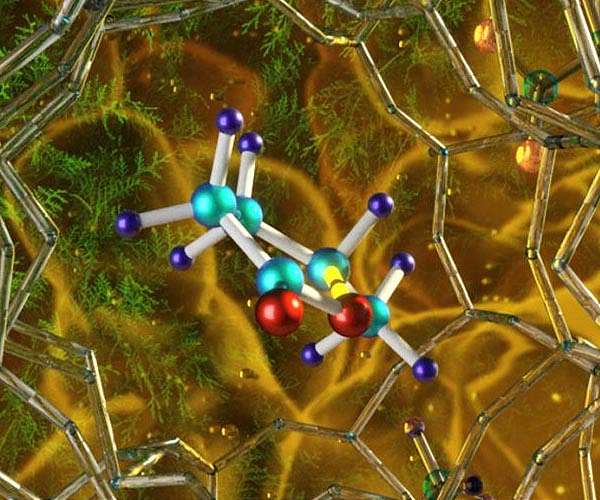
Zeolites are critical in various industries, yet understanding their catalytic properties remains challenging due to the complexity of hydroxyl-aluminum groups. Comprehensive atomic-scale analysis is vital for unraveling the catalytic activity of zeolites and for the development of efficient catalysts. Many factors, such as low quantities, meta-stable properties, and structural similarities, often hinder detailed structural analysis.
Professors HOU Guangjin and CHEN Kuizhi from the Dalian Institute of Chemical Physics (DICP) at the Chinese Academy of Sciences have made significant strides in mapping the intricate hydroxyl groups within zeolites. Their research, published in the Journal of the American Chemical Society, utilizes innovative coupling-edited 1H-17O solid-state nuclear magnetic resonance (NMR) techniques developed by the team.
The 17O solid-state NMR, though challenging due to the isotope's low natural abundance and complex properties, was enhanced through a novel 17O-enrichment method. This advancement facilitated the development of new spectral editing pulse sequences that enhance spectral resolution and reveal minute protonic structures in zeolites.
This method notably overcomes the 2nd-order quadrupolar-dipolar cross-term interaction, which typically obscures NMR readings, thus enabling precise identification of crucial species within the zeolite structure. The team also quantified proximity interactions like Al—H and O—H, and semi-quantitatively assessed the dissociation rates of hydroxyl protons at BrOnsted acid sites, shedding light on the local environment of key Al-OH and Si-OH groups.
This breakthrough in NMR technology not only advances our understanding of zeolite structures but may also apply to other areas such as metal-oxide surfaces, metal-organic frameworks, and biomaterials. "Our method could serve as a universal approach for high-resolution analysis of subtle protonic structures," stated Prof. HOU.
Research Report:Precise Structural and Dynamical Details in Zeolites Revealed by Coupling-Edited 1H-17O Double Resonance NMR Spectroscopy
