
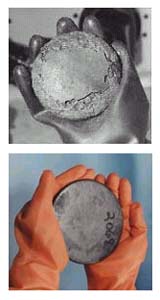
Zircon ceramics, proposed as a solution for the headache of plutonium waste, would be swiftly degraded by radioactive bombardment, scientists have learnt. More than five decades after the first commercial nuclear reactor began generating power, waste stockpiles have reached the point where numerous countries are pushing ahead with multi-billion-dollar plans for long-term storage of this hazard.
Their biggest problem is highly radioactive waste, especially plutonium, which has to be stored for tens of thousands, even hundreds of thousands of years before it can be deemed safe.
As plutonium decays, it emits alpha particles, which are high-energy particles that wack into the atoms that make up the container structure. The structure's neat atomic order is jostled, eventually compromising its strength.
Synthetic zircon has emerged as a leading proposed contender for storing high-level waste, because zircon, as a crystal, is able to contain naturally-occurring uranium for millions of years.
Scientists at the University of Cambridge in Britain used nuclear magnetic resonance (NMR) spectroscopy, a technique to assess the atomic structure of materials, to see how natural zircon coped with exposure to plutonium 239.
They had expected each alpha particle to jostle between 1,000 and 2,000 zircon atoms, but the tests showed that in fact 5,000 were displaced.
On this basis, a synthetic zircon container could start leaking radioactivity after only 1,400 years, they calculate.
"This time is very short in terms of the ideal immobilisation of plutonium 239 for … 241,000 years," say the authors, led by Ian Farnan of the university's Department of Earth Sciences.
The paper appears on Thursday in Nature, the weekly British science journal.
Source: Agence France-Presse
