
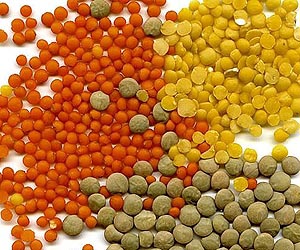
The U.S. Agricultural Research Service says it is getting ready to make public a newly developed variety of lentil called Essex.
The service, a part of the U.S. Department of Agriculture, says Essex offers high seed yields for growers, nitrogen-fixing bacteria for wheat crops and a tasty source of protein for consumers to add to soups, salads and other fare.
The lentil variety was developed by plant geneticist George Vandemark, who leads the ARS Grain Legume Genetics and Physiology Research Unit in Pullman, Wash., in collaboration with retired ARS scientist Fred Muehlbauer and Kevin McPhee, a pulse crop breeder at North Dakota State University.
"Essex was chosen for public release based on its outstanding performance in advanced yield trials conducted over the past couple of years in Washington State, Idaho, North Dakota and Montana," the ARS said in a statement "During trials, Essex averaged 1,220 pounds of seed per acre, which is 21 percent more than Eston and 22 percent more than Athena, two leading commercial varieties that the researchers used for comparison."
Essex is intended for production in the Pacific Northwest and Northern Plains, with primary markets in Mexico and other Latin American nations. Officials said the variety might be ready for sale to growers next year.
The research is to appear in an upcoming issue of the Journal of Plant Registrations.
Share This Article With Planet Earth
