
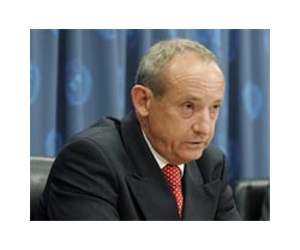
UN climate chief Yvo de Boer defended his record on Thursday after suddenly announcing his resignation and argued that the much-criticised format for tackling global warming had a good future.
In a phone interview with AFP from Germany, de Boer denied that any political pressure lay behind his decision to quit as executive secretary of the 194-nation UN Framework Convention on Climate Change (UNFCCC).
Appointed to the job in September 2006, de Boer is to resign from July 1, three months ahead of schedule.
He is to take up a career as a climate advisor in the private sector and also work with universities, the UNFCCC announced in Bonn.
"If you look back through my CV, I have a history of trying to do something different every three or five years or so," de Boer, 55, said.
"This job has been absolutely fantastic… but it's also been very taxing for me personally and for my family, and I'm ready for a new challenge."
The announcement came barely two months after a near-fiasco at the UNFCCC's summit in Copenhagen, the high point of a two-year effort to craft a post-2012 treaty on climate change.
The meet was salvaged at the last minute by a core group of major carbon-emitting countries, whose leaders stitched together a deal for limiting global warming to two degrees Celsius (3.6 degrees Fahrenheit).
But the accord failed to get the seal of approval at a plenary session, after a number of countries from Latin America and Africa railed at its unambitious scope and at being excluded from the haggle.
"At the end, people were exhausted, people were frustrated," said de Boer.
"I think if we had had a moment of rest to reflect on the Copenhagen Accord and its political significance, we could perhaps have had a stronger result in legal terms."
Backers of the Copenhagen Accord say it is the first time that rich and poor nations are being asked to make pledges for curbing emissions of greenhouse gases. It also details 30 billion dollars in help for poor countries by 2012, with a possibility of hundreds of billions more by the end of next decade.
Critics, though, have decried it as a poor fudge, with no details for achieving the 2C (3.6 F) goal and whose pledges are only voluntary.
"Copenhagen was disappointing in that it didn't deliver a formal, legally-binding agreement," said de Boer.
But, he added, "the presence of 120 heads of state and government and the fact that countries accounting for 80 percent of energy-related CO2 emissions have now submitted targets and plans is an indication that the world has decided to move on this topic in a global way."
Some of the political fallout from Copenhagen has been directed at de Boer, accused from the sidelines of having over-stoked expectations or promoted issues favouring developing countries.
"There are people who say I overstepped the boundaries of my job description," admitted de Boer.
"I actually don't have a job description. But if I had one, I am sure I would have overstepped the boundaries and I did that consciously, because I think that this is an issue that needs to be elevated to the top of the political agenda."
De Boer added that despite their problems and complexity, the climate negotiations remained essentially in good shape.
Lessons could be learned from Copenhagen but there was no traction among UNFCCC members for ditching the principle of consensus or of prioritising emissions curbs over help for poor countries, he said.
"We are not in a baby-and-bathwater situation," he added.
"To get the big guys together and only focussing on emissions basically means turning your back on hundreds of millions of impoverished people around the world who have no voice but will have to face the consequences" of climate change, de Boer said.
"These issues are interconnected, and I think that the UN process is a strong expression of solidarity. Solidarity takes time, but respecting solidarity brings real, sustainable benefits."
Share This Article With Planet Earth
