
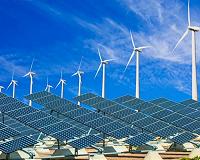
A new study from the United States Department of Energy's (DOE) National Renewable Energy Laboratory (NREL) used high-performance computing capabilities and innovative visualization tools to model, in unprecedented detail, how the power grid of the eastern United States could operationally accommodate higher levels of wind and solar photovoltaic generation. The analysis considered scenarios of up to 30 percent annual penetration of wind and solar.
Whereas previous studies have investigated operations in one-hour intervals, NREL's Eastern Renewable Generation Integration Study (ERGIS) analyzed a year of operations at 5-minute intervals, the same real-time interval used by grid operators for scheduling resources.
"By modeling the power system in depth and detail, NREL has helped reset the conversation about how far we can go operationally with wind and solar in one of the largest power systems in the world," said the Energy Department's Charlton Clark, a DOE program manager for the study. "Releasing the production cost model, underlying data, and visualization tools alongside the final report reflects our commitment to giving power system planners, operators, regulators, and others the tools to anticipate and plan for operational and other important changes that may be needed in some cleaner energy futures."
For the study, NREL produced a high-resolution model of the entire Eastern Interconnection, including Canada, an important power trading partner with the United States. NREL modeled more than 5,600 electricity generators and more than 60,000 transmission lines in a power system that spans from Florida to Maine and portions of Canada and as far west as New Mexico.
ERGIS considered four hypothetical scenarios to analyze how the Eastern Interconnection might function in 2026, when the power system could have significantly less power generation from fossil fuels. The scenarios vary according to how wind, solar, and natural gas are used to replace the fossil fuel generators. The scenarios also differ according to the amount of new transmission lines that are assumed.
Simulations occur in a modeling framework that mirrors the security constrained unit commitment (SCUC) and economic dispatch (SCED) process used by system operators. The SCUC and SCED determine the operation of the power system according to a variety of constraints, including marginal costs and defined operating reserve requirements.
The capital costs, land use and siting, market design, gas pipeline, and other factors that would need to be addressed under the scenarios were not considered. This study also did not look at all aspects of reliability considered by system planners and operators, including system dynamics and AC power flow.
"Our work provides power system operators and regulators insights into how the Eastern Interconnection might operate in future scenarios with more wind and solar energy," said Aaron Bloom, NREL project leader for the ERGIS study. "More importantly, we are sharing our data and tools so that others can conduct their own analysis."
