
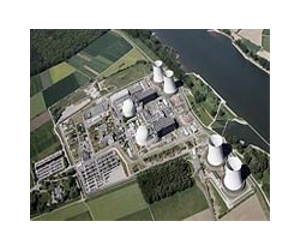
Germany's decision to switch from nuclear to renewable sources of energy will require investment of 250 billion euros ($340 billion) over the next decade, a new study found Monday.
According to the study by the state-owned investment bank KfW, the planned realignment of Germany's power supply from nuclear to renewables will require "additional investment needs of around 250 billion euros by 2020."
KfW describes itself as one of the leading sources of finance in the energy sector, estimating that it financed 80 percent of new wind turbines installed in Germany last year, plus 40 percent of solar panels.
The bank also financed the insulation of buildings.
In the wake of the nuclear catastrophe in Fukushima, Japan, the German government has decided to shut down all of its nuclear reactors by the end of 2022.
At the same time, renewables are to account for 80 percent of total electricity generation by 2050, compared with 17 percent last year, the KfW study said.
Rosatom eyes Siemens cooperation despite nuclear exit
Moscow (AFP) Sept 19, 2011 –
Russian state nuclear company Rosatom will pursue cooperation with Germany's Siemens even though Siemens has decided to drop its nuclear energy projects, a Rosatom spokesman told AFP on Monday.
"Cooperation will continue in other spheres. Working groups are continuing the talks on this issue," said spokesman Sergei Novikov.
Siemens chief executive Peter Loescher announced on Sunday in an interview with Der Spiegel that it is quitting the nuclear energy business due to Germany's goal to phase out nuclear plants after Japan's Fukushima disaster.
The group is therefore scrapping its long-planned project to create a joint venture with Rosatom, which the companies announced in March 2009, Loescher said.
"Siemens is following the position of the German government, which made the decision to gradually abandon nuclear energy," Rosatom's Novikov said.
Rosatom may continue cooperation with Siemens outside the field of nuclear energy, for example in the nuclear medicine industry, he added.
"Siemens is one of the leading producers of equipment for nuclear medicine, while Rosatom is one of the leading producers of isotopes used in nuclear medicine."
Rosatom signed a memorandum of understanding with Siemens to create a joint venture, but this enterprise was never created in the end, Novikov said.
Its creation had been delayed after Siemens' former partner, French nuclear giant Areva, went to arbitration to try to block the Rosatom deal in a case that only ended in May, after the Fukushima disaster in March.
Areva eventually forced Siemens to pay 648 million euros ($927 million) for violating its shareholder pact by ending their cooperation to make the Rosatom agreement.
