
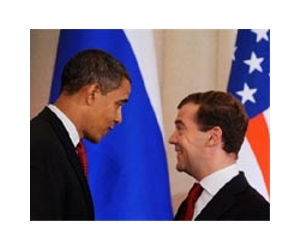
Nuclear tensions between Washington and Moscow used to terrify the world, but joint work by the historic rivals at a nuclear security summit Tuesday has underscored how close their relationship has become.
Major sticking points remain, from Russia's continued failure to win World Trade Organization membership to differences over planned US missile defenses in Europe.
But the 47-nation nuclear summit hosted by US President Barack Obama in Washington highlighted major strides in the always complex US-Russian relationship.
"We have managed to change the atmosphere," Russian President Dmitry Medvedev said about the recent so-called "reset" in US-Russian ties.
Medvedev said the summit on securing the world's poorly guarded nuclear materials was a "full success."
It came a week after Medvedev and Obama signed a landmark treaty committing the former Cold War foes to slashing their nuclear warheads by a third.
And according to Medvedev, this kind of partnership is here to stay.
"We will work with the United States on the most important global problems," the Russian leader said, signaling that Moscow was prepared to turn the page on often-testy ties with Washington.
"Russia needs a responsible, peaceful, authoritative and dynamically developing America."
Russia contributed Tuesday to a raft of proposals by summit participants for reducing world stockpiles of weapons grade radioactive material by promising to shut down its last weapons-grade plutonium reactor.
Obama welcomed the move, calling the closure of the Soviet-era site in Siberia an "important step" for bolstering nuclear security.
Shutting down the reactor showed "Russia's leadership on nuclear security issues, and will add momentum to our shared global effort," Obama said.
Earlier, the two countries had signed a protocol pledging to dispose of 34 tons of excess weapons-grade plutonium each, enough to make 17,000 weapons.
The nuclear thaw does not mean an end to the often testy nature of US-Russian ties.
Speaking to journalists after the summit, Medvedev complained bitterly about Russia's exclusion from the World Trade Organization, saying "we should have been in the WTO a long time ago."
Russia is the world's largest economy outside the global trade body and has repeatedly accused Washington of hindering its efforts to join.
Medvedev said his country wanted to be part of the WTO but its accession "should be done quickly, without humiliation or new demands."
Certainly Washington and Moscow have largely closed the once yawning gap on the flashpoint issue of UN sanctions against Iran's nuclear program.
But although Obama's drive for sanctions appears to be gaining traction, the toughness of those measures remains very much a matter of debate.
In an interview on Monday with US television, Medvedev said he agreed sanctions were needed, but that the country's crucial oil trade should remain off limits.
"If we're talking about energy sanctions, I'll tell you my opinion. I don't think on that topic we have a chance to achieve a consolidated opinion of the global community on that," Medvedev said.
"Sanctions should not be paralyzing. They should not cause suffering."
Moscow also remains deeply suspicious of a proposed US missile defense program in Europe.
Even cooperation in the nuclear field has its limits.
With November elections on the horizon and a bitterly partisan climate in Washington, there are uncertain prospects for US ratification of the nuclear arms limitation pact signed by Obama and Medvedev.
The Russian leader on Tuesday urged US lawmakers to approve of the treaty, saying, "If there is no ratification that means we have returned to the Soviet times when such treaties were not ratified."
Medvedev also sought to underline the positive, though, saying, "I don't remember a more problem-free summit."
"We should not be seeking differences, we should build long-term pragmatic relations," he said.
Share This Article With Planet Earth
