
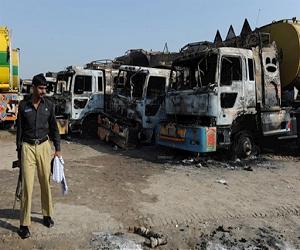
One person was killed Wednesday when at least 10 NATO oil tankers were set ablaze in the southwest Pakistan city of Quetta, senior police officials said — the fourth such attack in six days.
Unknown gunmen attacked the terminal where up to 40 tankers were parked, and opened fire, senior police official Hamid Shakeel told AFP.
"There are at least 10 tankers on fire. One person, apparently one of the staff members of the terminal, died as a result of gunfire," he said.
Another senior police official, Shah Nawaz, confirmed the incident in the city's western outskirts, and the casualty.
The main land route for NATO supplies crossing from Pakistan to Afghanistan was closed for a seventh consecutive day, after a cross-border NATO helicopter attack that officials blamed for the deaths of three Pakistani soldiers.
The alliance said it shot back in self-defence.
NATO chief Anders Fogh Rasmussen has urged Pakistan to reopen the vital route "as soon as possible".
Since the key route closed, local Taliban militants have claimed two raids in which nearly 60 trucks were torched, and vowed more attacks.
Three people were killed in one incident when about 20 NATO oil tankers were set ablaze by attackers armed with Molotov cocktails near Islamabad.
In a similar incident on Friday in the south, heavily armed gunmen set fire to more than two dozen trucks and tankers carrying fuel for the 152,000-strong foreign forces fighting the Taliban-led insurgency in Afghanistan.
Two NATO trucks were also torched by unknown assailants in the Qalat district of Baluchistan on Monday.
Ambushes of NATO convoys are not uncommon, but are normally concentrated in the militant strongholds of the northwest.
The Taliban said its attacks were to avenge US drone attacks and halt the NATO supply route through Pakistan.
The United States has massively increased its drone campaign in Pakistan's lawless northwest tribal region on the Afghan border, which it calls the global headquarters of Al-Qaeda and is a hub of militants fighting in Afghanistan.
earlier related report
Canadian sacked from army for shooting wounded insurgent
Ottawa (AFP) Oct 5, 2010 –
A Canadian army officer was sacked from the military on Tuesday for the 2008 shooting of an unarmed and severely wounded Afghan insurgent in what prosecutors at his trial alleged was a mercy killing.
Captain Robert Semrau, 36, was convicted in July of behaving disgracefully for shooting a presumed Taliban fighter, in the first Canadian prosecution of its kind.
However, prosecutors failed to prove their key accusation that the soldier actually killed the insurgent in a misguided and illegal act of battlefield euthanasia.
At sentencing, Judge Jean-Guy Perron ordered Semrau's dismissal from the military at the reduced rank of second-lieutenant, saying Semrau had failed as a leader.
"Shooting a wounded and unarmed person is disgraceful because it is so fundamentally contrary to our values and training that it is shockingly unacceptable," Perron said.
"Your actions may have been motivated by a sense that you were doing the right thing. Nonetheless you committed a serious breach of discipline," the judge said.
"How can we expect our soldiers to follow the rules of war if their officers do not?"
Semrau joined the Canadian Forces in 2005 after serving several years with the British Armed Forces. His military career was unblemished before murder charges were laid in this landmark case.
Semrau's military defense lawyer, Captain David Hodson, said Semrau was "very disappointed" by the sentence. "He's a warrior" who wishes to be "serving his country."
The prosecution had sought a jail term.
The three-month trial heard that Semrau's troops were on patrol in Helmand province on October 19, 2008 when they were ambushed by Taliban fighters.
During that period Canadian soldiers were facing an increasingly tough insurgency as they defended key positions in the region. Semrau was mentoring Afghan soldiers as part of a NATO program.
Following several clashes, British and Afghan troops along with their Canadian mentors came across two "presumed" Taliban fighters: one dead, the other too severely wounded for treatment on site.
Prosecutors said the wounded man was "still alive, moving slightly and moaning" and as the patrol moved off, Semrau fired two shots that prosecutors alleged killed the insurgent.
According to witness testimony, Semrau told a private under his command "that he couldn't live with himself if he had left a wounded human being and nobody should be made to suffer like that."
Neither Canadian, nor international law recognizes mercy killings.
Canadian soldiers killed prisoners on the battlefield during the 1950-1953 Korea war, and during World War II after D-Day in retaliation for the murder of Canadians by the German SS, but charges were never laid in those cases.
The Afghan killing went unreported for two months until an Afghan soldier and the Canadian private disclosed it.
Investigators later recovered two 5.56 mm shell casings at the scene, allegedly shot into the insurgent's chest at close range, but the victim's body was never found.
Share This Article With Planet Earth
