
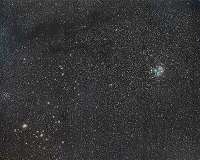
Scientists studying a cold molecular cloud of the Taurus region with radio telescopes have detected the presence of a particular organic molecule called benzonitrile. The finding marks the first time a specific aromatic molecule has been identified in space using radio spectroscopy.
It also sheds light on the composition of aromatic material within the interstellar medium – material that will eventually be incorporated into new stars and planets.
Organic molecules containing a hexagonal ring of carbon atoms, known as aromatic molecules, are abundant throughout the Universe. Astronomers know this because aromatic molecules emit a characteristic set of emission features in the infrared, which are observed in many space environments.
However, identifying precisely which aromatic molecules are present is very difficult, and usually requires radio spectroscopy. Improved methods for detecting weak radio emission are helping scientists gain a better glimpse into the cosmos.
Brett A. McGuire et al. took advantage of such a method, a so-called spectral-stacking procedure, to find signatures of benzonitrile while combing through a radio survey of the Taurus Molecular Cloud 1 (TMC-1).
To confirm their identification, they conducted thorough laboratory experiments to accurately measure the different rotational transitions of the molecule. By comparing their experimental data to targeted observations of TMC-1 using another radio telescope, they were able to observe nine different rotational transitions of benzonitrile, solidifying the detection.
Christine Joblin and Jose Cernicharo discuss the implications of these findings in a related Perspective. Studying the composition of organic molecules in space is key for understanding molecular complexity in protoplanetary disks surrounding young stars, among other applications, they say.
Cosmic dust, not 'alien megastructure,' veils mysterious star
It's been called the "most mysterious star in the universe," bigger than the sun and yet brightening and dimming in an odd way that suggested to some an alien megastructure might be circling it.
But a study out Wednesday, compiled by more than 100 scientists who have been observing the star named KIC 8462852, puts the alien rumors to rest.
"Dust is most likely the reason why the star's l … read more
