
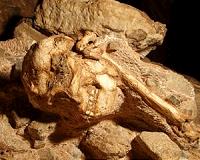
After 20 years of careful excavation, paleontologists are finally ready to present the world's most complete Australopithecus fossil found to date.
The Little Foot fossil is 3.67 million years old, making it South Africa's oldest virtually complete fossil of a human ancestor. It's also one of the oldest hominids recovered from southern Africa.
Little Foot was alive some 500,000 years before the continent's most famous Australopithecus hominid, Lucy, who was found in Ethiopia. Lucy and Little Foot both belong to the Australopithecus genus but are separate species.
The remains of Little Foot were first discovered two decades ago by Ron Clarke, a professor at the University of the Witwatersrand's Evolutionary Studies Institute in Johannesburg. Little Foot's presence in the rock and soil of a South African cave was first revealed by four small foot bones — ultimately, inspiring the hominid's name. Further excavation revealed a near-complete skeleton.
"This is one of the most remarkable fossil discoveries made in the history of human origins research and it is a privilege to unveil a finding of this importance today," Clarke said in a news release.
Little Foot was a female, a young girl. She likely slept in trees. Scientists believe she died after falling down a shaft in the cave. Despite her propensity for climbing, her shorter arms and smaller hands suggest she looked more like modern humans than like an ape.
The knowledge of her appearance was made possible by thousands of man-hours of intricate work.
"Many of the bones of the skeleton are fragile, yet they were all deeply embedded in a concrete-like rock called breccia," Clarke said. "The process required extremely careful excavation in the dark environment of the cave."
Twenty years after the initial discovery, the process of excavation, cleaning, reconstruction, casting, imaging and analysis is complete, and researchers are ready to reveal Little Foot to the world.
Though now on display, scientists will continue to study Little Foot's anatomy to ascertain her place on the hominid family tree — and to shed further light on the story of early human evolution.
Trump removes protection for swaths of Utah parks
US President Donald Trump slashed the size of two Utah conservation areas Monday, the first such large-scale reversal in more than 100 years.
Trump traveled to Salt Lake City to announce that he was cutting 85 percent of the vast Bears Ears National Monument and around 45 percent of the Grand Staircase-Escalante National Monument.
Trump painted the decision as giving government-held land … read more
