
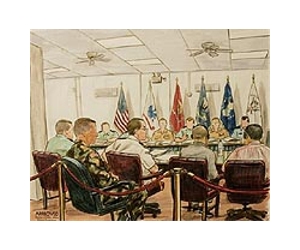
The Pentagon has banned four journalists from covering trials at Guantanamo after they published the name of an interrogator testifying at a hearing.
The Pentagon said Thursday reporters from the Miami Herald and three Canadian news organizations, the Toronto Star, The Globe and Mail and CanWest news service, had violated a request from the military judge to keep the identity of the witness secret.
"As a result of these violations, these individual reporters are barred from returning to cover future Military Commissions proceedings," Colonel Dave Lapan wrote in an email to the reporters' editors.
"Your news organizations may continue to cover the proceedings with other reporters," he said.
But if those journalists failed to abide by the Pentagon's rules, the news organizations could be banned entirely from the proceedings, the email said.
Reporters who attend the Guantanamo military commissions must agree to "ground rules" issued by the Defense Department, prohibiting the release of information deemed secret by the court or Pentagon public affairs officials.
The decision came amid pre-trial hearings in the case of Omar Khadr, a Canadian who was 15 when he was captured in Afghanistan in 2002 and who faces charges he killed a US soldier in a grenade attack.
The interrogator's identity had already been reported in previous news accounts and in 2008 the interrogator gave an on-the-record interview to one of the banned reporters, Michelle Shephard of the Toronto Star, author of a book about the Khadr case, "Guantanamo's Child."
"Interrogator No. 1," as the Guantanamo court identified him, had been sentenced to five months in prison in 2005 after he pleaded guilty in a court-martial to abusing an Afghan detainee who was found dead at the Bagram US military base.
According to journalists in Guantanamo, the decision came after interrogator No. 1 testified that he used the threat of being gang raped in a US prison by "four big black guys" to scare Khadr into talking.
Apart from Shephard, the reporters banned were Carol Rosenberg of the Miami Herald, Paul Koring of the The Globe and Mail, and Steven Edwards of CanWest news service.
The news organizations said they would appeal the Pentagon's decision.
"We have been covering Guantanamo for years and we've always played by rules — and we did in this case as well," Mindy Marques, managing editor of The Miami Herald, said in an article on the paper's website.
"We expect to sort this out and continue to cover this important story, as we have always done."
The Herald's reporter, Rosenberg, has been covering the military tribunals in Guantanamo since proceedings started in 2004.
The move to ban the reporters was an administrative decision and not based on a judicial ruling that the journalists had violated any court order, a reporter in Guantanamo told AFP.
The American Civil Liberties Union called the decision "rash, draconian and unconstitutional."
"That reporters are being punished for disclosing information that has been publicly available for years is nothing short of absurd — any gag order that covers this kind of information is not just overbroad but nonsensical," Jameel Jaffer, ACLU deputy legal director, said in a statement.
Khadr is the first detainee to have his case heard since the controversial system for trying "war on terror" suspects was reformed under President Barack Obama.
Share This Article With Planet Earth
