
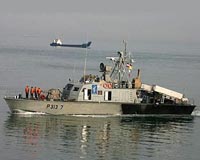
The Pentagon on Monday blasted the "unprofessional" behavior of the Iranian navy after two separate incidents in the Strait of Hormuz last week.
According to the Pentagon, an Iranian frigate on Thursday came within 150 yards (meters) of the civilian-crewed USNS Invincible.
Then on Saturday, a number of small assault craft came within 350 yards of the Invincible and other ships.
"This was assessed to be a combination of unsafe or unprofessional behavior," Pentagon spokesman Navy Captain Jeff Davis said.
In both cases, the US ship had to change course to avoid any collision, he added.
"It's concerning because it can result in a miscalculation or an accidental provocation that we don't want," Davis said, noting that Iranian actions in the crowded sea had actually been improving of late.
The Pentagon has previously voiced concern over a string of high-profile incidents in waters off Iran, where the Iranian Revolutionary Guard Corps (IRGC) frequently conducts risky maneuvers around US vessels, including some where the Americans have had to fire warning shots.
The USNS Invincible is equipped with powerful radar equipment that can follow ballistic missile trajectories.
The prefix "USNS" means the ship belongs to the US Navy but is unarmed or only lightly armed.
US hasn't decided yet on Iran nuclear deal: IAEA
Vienna (AFP) March 6, 2017 –
The new US administration has not yet decided what to do about the 2015 Iran nuclear deal, the head of the UN atomic watchdog said Monday following talks in Washington.
"The new administration of the United States just started and they are looking at this issue," International Atomic Energy Agency chief Yukiya Amano said.
They are looking "not only at that issue but also at many other issues. So it is very early for them to give their assessment," he told a news conference.
Amano held talks on Thursday with US Secretary of State Rex Tillerson and other senior officials in Washington for the first time since Donald Trump became president in January.
Trump said while campaigning for the presidency that he wanted to "dismantle" the July 2015 nuclear deal between Iran and six major powers including the United States.
The agreement saw Iran scale down substantially its nuclear activities and submit to ultra-close IAEA inspections in exchange for relief from painful sanctions.
The accord extends the "breakout time" needed for Iran to accumulate enough fissile material for a bomb to at least a year, giving the international community time to react, proponents say.
Iran has always denied wanting nuclear weapons, saying its activities are purely peaceful. Amano said Monday the deal was a "net gain from a verification point of view".
Regardless of Trump's barbs on the campaign trail, none of the five other major powers to the deal — Britain, China, France, Russia and Germany — want to end the agreement.
The IAEA has said that Iran has complied with the accord's conditions since it formally came into force in January 2016.
US hasn't decided yet on Iran nuclear deal: IAEA
The new US administration has not yet decided what to do about the 2015 Iran nuclear deal, the head of the UN atomic watchdog said Monday following talks in Washington.
"The new administration of the United States just started and they are looking at this issue," International Atomic Energy Agency chief Yukiya Amano said.
They are looking "not only at that issue but also at many other is … read more
