
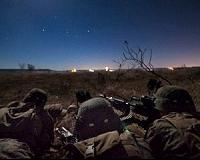
The Pentagon said Sunday President Donald Trump had ordered the withdrawal of up to 1,000 troops from northern Syria — almost the entire ground force in the war-torn country — amid an intensifying Turkish assault on Kurdish forces.
Defense Secretary Mark Esper said the move came after the US learned that Turkey was pressing further into Syria than expected.
The Kurds — with whom the US partnered to combat the Islamic State (IS) group — later announced they had reached a deal with the regime in Damascus to deploy Syrian troops near the border to confront the Turkish offensive.
"We have American forces likely caught between two opposing advancing armies and it's a very untenable situation," Esper told CBS's "Face the Nation."
"So I spoke with the president last night after discussions with the rest of the national security team and he directed that we begin a deliberate withdrawal of forces from northern Syria."
Esper said he was unable to provide a timeline because of the changing situation on the ground, but added that the withdrawal would be carried out in a "very safe, deliberate manner."
"It's a very terrible situation over there, a situation caused by the Turks… Despite our opposition they decided to make this incursion into Syria," Esper told CBS.
"And at this point in time in the last 24 hours we learned that they likely intend to expand their attack further south than originally planned and to the west."
– Bipartisan firestorm –
Esper also pointed to a possible deal — confirmed later Sunday by the Kurdish administration in northern Syria — on a Syrian troop deployment near the border with Turkey to help the Kurdish-led Syrian Democratic Forces (SDF) confront Ankara's offensive.
The US withdrawal announcement came after its troops came under artillery fire Friday which the Pentagon said was from Turkish positions.
Asked if troops would be leaving the country altogether, Esper clarified that the withdrawal was just from northern Syria, "which is where most of our forces are."
Fighting raged Sunday along the border on the fifth day of an offensive that has provoked an international outcry and left dozens of civilians and fighters dead.
Ankara launched the long-threatened offensive against the SDF, which it considers "terrorists" linked to insurgents inside Turkey, after Trump ordered special forces serving as a trip wire against Turkish action to pull back from the border.
The withdrawal provoked a bipartisan firestorm of criticism in the US and accusations that Trump was abandoning a loyal ally in the fight against IS militants.
– 'Derelict in his duty' –
"The president is simply derelict in his duty as president. He is making Americans much less safe, he is undoing years of work to curb (IS)," top Senate Democrat Chuck Schumer said in a statement on Sunday.
"He is making America more susceptible to terrorism by his actions."
Trump hit back, describing the US withdrawal as "very smart."
"The Kurds and Turkey have been fighting for many years… Others may want to come in and fight for one side or the other. Let them! We are monitoring the situation closely. Endless Wars!" he said.
Hundreds of relatives of foreign jihadists have escaped from a displacement camp in northern Syria, Kurdish authorities said Sunday, as the number of people fleeing the Turkish assault soared to 130,000.
Ankara's offensive sparked fears that thousands of IS fighters held by Syrian Kurdish forces could break free.
Trump tweeted on Sunday that "the U.S. has the worst of the ISIS prisoners," using an acronym for IS, but added: "Turkey and the Kurds must not let them escape."
Treasury Secretary Steven Mnuchin announced Friday that Trump had authorized — but not yet activated — new sanctions to dissuade Turkey from further offensive military action.
"We can shut down all US dollar transactions with the entire government of Turkey," Mnuchin told ABC on Sunday.
"It's something we may do. There's full authority and something at a moment's notice the president can tell me to do."
Rebel faction takes frontline role in Turkey offensive
Istanbul (AFP) Oct 12, 2019 –
In the vanguard of Syrian revolt before being ripped apart by division and indiscipline, the Free Syrian Army has returned as a key component of Turkey's offensive against Kurdish militants.
The broad-ranging coalition styled itself as the moderate force against Syrian President Bashar al-Assad, but lacked the funding and support to compete with extremist groups such as Al-Nusra and the Islamic State (IS) when they emerged around 2012.
Having all but disappeared for several years, the Free Syrian Army regained the spotlight in 2016 when it participated alongside Turkish forces in Ankara's first incursion into northern Syria against IS.
But images of FSA fighters posing with mutilated bodies of Kurdish militants and looting stores during a second Turkish operation in Afrin two years later undermined their reputation for moderation.
The group recently rebranded itself as the Syrian National Army (SNA), under the authority of the opposition's "interim government" in exile, based in Turkey.
They are armed, trained and paid by Ankara, and once again joined Turkish soldiers this week as part of "Operation Peace Spring", launched on Wednesday against Kurdish forces in northeastern Syria.
"The Syrian National Army is the indigenous component of the Turkish operation. It's an important infantry force for the offensive," said Emre Kursat Kaya, of the EDAM think-tank in Istanbul.
"The group is formed around Sunni Arab and Turkmen fighters who are locals of the region. Thus, their presence in the operation provides an undeniable intelligence advantage."
The SNA now claims to have some 80,000 men at its disposal, having boosted its ranks earlier this month by integrating another coalition, the National Liberation Front, based primarily in Idlib province.
Some 14,000 of its fighters have been mobilised for the new operation, according to the group's spokesman, Major Yusuf Hamoud.
"That number can increase as the battle unfolds," he told AFP.
A large number of these fighters come from areas targeted by the Turkish offensive, he said, which is aimed at pushing back the Kurdish People's Protection Units (YPG) militia.
"These soldiers were forced to leave when the YPG took control" of territories such as Tal Abyad and Ras al-Ain, he added.
– 'Tight control' –
Turkey has so far deployed around 1,000 SNA soldiers in the Tal Abyad and Ras al-Ain areas, estimates Charles Lister, of the Middle East Institute.
"For now, the SNA appears to be operating under the tight control of the Turkish military and Ankara is using them as the primary force," he told AFP.
Lister said this mirrored the way that the US had used the Kurdish-led Syrian Democratic Forces in their battle against the Islamic State group.
"Their role is crucial for now," Lister said. "Turkey's strategy is not just to train these forces, but to give them sufficient operational experience so that once territory is captured they will operate as capable hold-forces wholly loyal to Ankara."
The challenge now will be to ensure that there is no repeat of the rights violations seen during their last deployment in Afrin.
The United States has warned Turkey that any abuses will result in severe economic sanctions.
In a statement published on Saturday, the SNA's "chief of staff" called on all commanders in the field "permanently supervise fighters on the frontline to prevent any violations or abuses."
Kaya, of the EDAM think-tank, believes Turkey will have taken measures to minimise these risks.
"These forces have been intensively trained by Turkish forces for this operation," he said.
"Turkey chose the most professional Syrian moderate forces to participate in this operation. We should also mention that elite Turkish commando forces on the ground will supervise the offensives and react to any excesses," he added.
After mixed messages, US piles pressure on Turkey
Washington (AFP) Oct 12, 2019 –
Facing a backlash for appearing to greenlight Turkey's assault against Kurdish forces in Syria, President Donald Trump on Friday dialed up pressure on America's NATO ally by threatening crippling sanctions.
The United States was moving to quash accusations of mixed messages and policy reversals over Turkey's offensive into northeastern Syria, which began after Trump ordered US troops to pull back from the border.
Turkey is targeting the Kurdish-led Syrian Democratic Forces (SDF), a key US ally in the five-year battle to crush the Islamic State group. The SDF lost 11,000 fighters in the US-led campaign.
Treasury Secretary Steven Mnuchin said Trump had authorized — but not yet activated — "very significant new sanctions" to dissuade Turkey from further offensive military action.
Defense Secretary Mark Esper weighed in forcefully, saying Turkey risked destabilizing the region and accusing President Recep Tayyip Erdogan of taking "impulsive action."
Esper "strongly encouraged" Turkey to halt the offensive, warning of "serious consequences," adding that he and Joint Chiefs Chairman Mark Milley had spoken directly to their Turkish counterparts.
Democrats and Republicans in Congress have united to back sanctions on Turkey if it launches a full assault on the SDF.
The series of US statements contrasted sharply with wayward signals sent by Washington since Trump said last Sunday that he expected Turkish troops to begin attacking.
Erdogan wants to create a buffer zone between the border and territory controlled by Syrian Kurdish forces, who have links with Turkey's own Kurdish rebels.
– US seeks to curb Turkey –
The US president initially voiced understanding of Turkey's wish to launch the offensive before later warning that the operation should be "humane" and offering to mediate.
He had come under heavy criticism, even among usually steadfast Republicans, over what many saw as the blatant betrayal of a faithful US ally.
But the choreographed US diplomatic effort to compel Turkey to minimize its offensive may have little impact on the ground.
Erdogan on Friday swiftly dismissed Esper's call for Turkey to stop the offensive.
"Now there are threats coming from left and right, telling us to stop this," Erdogan said. "We will not step back."
Turkish forces pressed ahead on Friday, battling to seize towns on the third day of the operation that has forced 100,000 civilians to flee.
"I have yet no indication that they are willing to stop," Esper admitted.
Turkey has launched mostly air and artillery attacks on the SDF and had only used "limited" ground forces, according to US military chiefs.
The Turkish action has not yet breached any "red lines" set by Trump, though details of the criteria remain unclear.
"We don't want them killing a lot of people… if we have to use sanctions we will," Trump said on Friday, giving no further details.
A few hours later, the Pentagon confirmed that US troops near the northern Syrian border came under artillery fire from Turkish positions.
No US personnel were hurt, but Pentagon spokesman Navy Captain Brook DeWalt warned Ankara against "actions that could result in immediate defensive action."
– Rising death toll –
The Syrian Observatory for Human Rights said Friday that the civilian death toll was 17 on the Syrian side, while 17 have also been killed in Turkey.
According to the Observatory, 54 fighters from the SDF have also been killed while Turkey has reported the deaths of four soldiers.
"Every concern I had about President Trump's Syria decision is coming true in spades," said Lindsey Graham, a loyal Republican senator and a leading voice on US foreign policy.
The offensive, the third such Turkish operation since the start of the war in Syria, has been met with fierce international condemnation.
But Trump has portrayed his decision to pull back troops as part of his election pledge to end US involvement in "ridiculous endless wars."
