
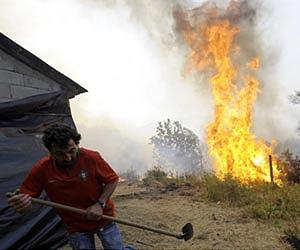
Fire raged through Portugal's Peneda-Geres national park for the sixth consecutive day, destroying large swathes of forest land, firefighters said on Monday.
Some 175 firefighters, equipped with waterbombing helicopters battled to contain the blaze, still active on several fronts, the civil protection services said on its website.
The flames have already destroyed 6,000 hectares (14,800 acres) in this risk-prone and inaccessible area to the west of the park, Fire Commander Carlos Ferreira was quoted as saying by the Lusa news agency.
The Peneda-Geres national park in northern Portugal contains more than 70,000 hectares of bushland, which sprawl across the border shared with Spain's Galicia region.
A smaller fire in the east of the park was also raging on Monday afternoon.
Authorities of the Peneda-Geres national park have not provided official figures from the fires, which have multiplied since the end of July, but said that several protected forests have been destroyed.
More than 15,000 fire starts have been registered since January and more than half of these since July 23, according to civil protection services.
More than 75,000 hectares of forestland across Portugal have been destroyed this year, with some 58,000 hectares burnt since the beginning of the month, according to satellite estimations from the European system of information on forest fires.
Several other protected zones were also destroyed by fires. In central Portugal last week, several thousands of hectares were burnt to the ground in the Serra da Estrela natural park, which also includes the European Network of Biogenetic Reserves.
On the island of Madeira, where fires have eaten through 3,100 hectares of bushland, the ecological park in Funchal, situated atop the city, has been almost entirely destroyed.
Miguel Albuquerque, mayor of Funchal, said on Monday that the park of 1,000 hectares would be replanted, but in autumn, due to the growing risk of flooding. The city was also devastated by floods last February which left 51 dead or missing across the island.
Share This Article With Planet Earth
