
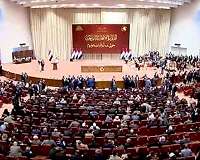
Iraq's parliament held its final session Saturday, leaving the country without a national assembly for the first time since 2013 as it awaits a vote recount from May parliamentary polls.
The manual recount was demanded by the supreme court in polling stations with contested results, in line with a decision by the outgoing parliament following allegations of fraud.
Parliament's deputy speaker Aram Sheikh Mohammed announced "the end of the third parliamentary mandate", at a gathering attended by 127 members of the 328-seat house.
Since the aftermath of the 2003 US-led invasion that toppled dictator Saddam Hussein, Iraq has had three parliaments each with a mandate of four years.
The last ballot was won by populist Shiite cleric Moqtada Sadr's electoral alliance with communists, as long-time political figures were pushed out by voters seeking change in a country mired in conflict and corruption.
Results of the May election were contested mainly by the political old guard.
The supreme court has ratified a decision by the outgoing parliament to dismiss Iraq's nine-member electoral commission and have them replaced by judges.
The judges' spokesman, Laith Hamza, said Saturday that the partial recount would start Tuesday in the Kurdish provinces of Arbil, Sulaymaniyah and Dohuk, as well as in Kirkuk, Nineveh, Salaheddin and Anbar.
Iraq begins border fence with Syria to block jihadists
Baghdad (AFP) July 1, 2018 –
Iraq has begun building a fence along its border with Syria to stop Islamic State group jihadists crossing into the country, a border guards spokesman said Sunday.
"Ten days ago we started to set up a barbed wire security fence with surveillance towers along the border with Syria," said Anwar Hamid Nayef, spokesman in Iraq's Anbar province.
The frontier barrier includes a six-metre-wide trench and involves thermal cameras and drones scanning the border for jihadists attempting to cross from Syria.
Baghdad declared victory over IS at the end of last year, but the group holds pockets of territory in the vast deserts of eastern Syria and maintains its ability to strike inside Iraq.
The new fence so far runs for 20 kilometres (12 miles) north from the area around the border town of Al-Qaim, which Iraqi forces retook from IS in November.
In total the frontier stretches for some 600 kilometres.
Border spokesman Nayef said that experts from Baghdad's ministry of defence and an anti-IS coalition spearheaded by the United States would come "to evaluate the effectiveness of the fence".
"If they approve the installations, we will continue along the whole border with Syria," he said.
In a sign of the continuing menace it poses to Iraq, the bodies of eight captives executed by IS were this week found along a highway north of Baghdad.
In a bid to combat the jihadists, Iraqi forces have carried out a series of air strikes against IS inside Syria.
