
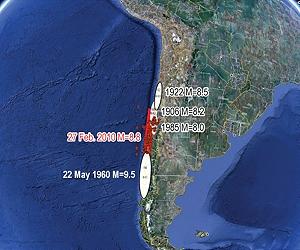
A Chilean-U.S. nuclear waste disposal arrangement was nearly derailed, with dangerous consequences for North and South America, when a magnitude-8.8 earthquake struck Chile Feb. 27, interfering with deliveries of radioactive waste to U.S. processing plants.
Chilean reports on the narrowly missed mishap involving the weapons-grade uranium, published by The Santiago Times, weren't immediately commented upon by industrial sources and officials.
Chile routinely sends nuclear waste from its nuclear research facility to the United States but a recent scheduled shipment coincided with the temblor that caused widespread devastation in Chile. Officials said the shipment was due to leave Feb. 28, a day after the earthquake.
For about nine months before the quake, Chilean experts worked to seal the uranium in specialized containers for shipment to the United States. About 40 pounds of enriched uranium was accumulated for a single shipment but the quake led security officials to review the complex procedure for the delivery of the uranium to specially configured vessels.
At first the quake raised fears the uranium boxes could have been damaged.
"They had to review everything again, in case there was some damage," said
Eduardo Cortes, a Chilean Nuclear Energy Commission who was involved with the transportation.
Experts involved with the shipment cited instances in which wrongly packaged and stored uranium waste could trigger explosions. The checks established the packages were safe, the experts said.
Further security operations came into force as security officials weighed risks of another tsunami and the risk of the various transportation stages being disrupted by the tsunami, officials said.
U.S. authorities took additional measures to ensure any mishap caused by the uncertain weather conditions didn't put lives at risk. The authorities decided to split the scheduled shipment and have the nuclear waste transported in special containers aboard different ships.
The shipment left Chile March 4 and arrived in the United States safely before it was handed to experts to convert the weapons-grade material into safe fuel.
Chile doesn't produce nuclear power but has a research reactor and the uranium usually is stored at the reactor site and a military base.
The quake caused widespread concern in Chilean and American nuclear communities. A U.S. team sent to Chile was especially keen to ensure the volatile material didn't set off a chain reaction while in transit.
Chile is keen to get started with nuclear power generation. A Chile Power Report said support had grown for a small-scale nuclear project to join the national power grid.
Share This Article With Planet Earth
