
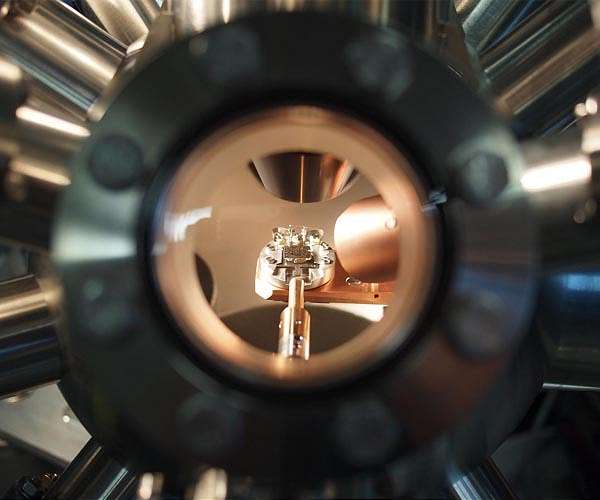
Researchers at the Institute of Industrial Science, The University of Tokyo have precisely detected the quantum tunneling of hydrogen atoms in palladium at low temperatures. This phenomenon, impossible for classical particles, allows hydrogen atoms to move through potential barriers within the palladium crystal lattice.
Hydrogen enters the palladium lattice by occupying interstitial sites between palladium atoms, with octahedral sites being stable and tetrahedral sites being metastable. At high temperatures, hydrogen hops between these sites by acquiring enough kinetic energy to overcome energy barriers. At lower temperatures, quantum effects allow hydrogen atoms to move by tunneling, aided by phonons – lattice vibrations – and conduction electrons present in the metal.
The research team used channeling nuclear reaction analysis to pinpoint the paths of hydrogen atoms as they hopped from metastable tetrahedral sites to stable octahedral sites by tunneling. The tunneling rate was measured through changes in electrical conductivity, illuminating the mechanism.
Lead author Takahiro Ozawa stated, "To understand the quantum nature of hydrogen, we need to identify the hopping pathway. Typical probes, like X-rays and electron beams, can't be used to detect hydrogen because of its small cross-section. Thus, we employed channeling nuclear reaction analysis to locate hydrogen in the palladium lattice."
Above 20 K, the tunneling rate increased slightly with temperature due to phonon effects, according to senior author Katsuyuki Fukutani. "However, below 20 K, the tunneling rate slightly decreased with the temperature, signaling the involvement of conduction electrons that could not perfectly follow the motion of the hydrogen atoms," Fukutani reported.
The findings provide deeper insight into hydrogen diffusion and offer prospects for technologies controlling atomic motion through quantum principles.
Research Report:Observation of proton tunneling correlated with phonons and electrons in Pd
