
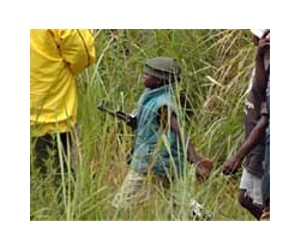
The Sudanese rebel group Justice and Equality Movement has signed an agreement allowing U.N. visits to its bases to verify it has no child soldiers.
JEM claims it doesn't recruit child soldiers and has been against using children for at least seven years.
The Darfur region guerrilla conflict began in February 2003 when the Sudan Liberation Army and JEM took up arms, accusing the Sudanese government of oppressing black Africans in favor of Arabs.
The signing by JEM is a milestone for the agreement put together by the Center for Humanitarian Dialogue, an independent mediation organization that brings together warring groups for discrete discussions.
The four-page Memorandum of Understanding between the United Nations and JEM is the first of what is hoped will be more signings by rebel groups in the Sudan. By signing the document, JEM is committed to handing over all children under 18 within its ranks, as well as any it finds among other rebel groups.
JEM must also "guarantee regular and unimpeded access" to its sites as well as its documents regarding recruitment.
The U.N. Children's Fund is the body that JEM will work with the most. JEM must "actively support UNICEF work on the protection and well-being of children."
The signing was between Georg Charpentier, the U.N. resident humanitarian coordinator in the Sudan and JEM's humanitarian coordinator Suleiman Jamous.
The use of child soldiers is widespread in Africa and the Middle East, most notably during the Lebanese civil war and the 1980-88 Iran-Iraq war. A decade ago, the U.N. estimated there were 10,000 child soldiers in the Sudan conflict on both rebel and government sides.
But UNICEF said around 6,000 child soldiers are used in the Sudan.
"UNICEF will have unimpeded access to all JEM locations to verify compliance with the agreement and the JEM will promise to designate a senior official as the focal point overseeing the agreement's implementation," a statement from the Center for Humanitarian Dialogue said.
If U.N. officials "find children in military areas, or in conflict areas, they will arrange for them to be removed," said Dennis McNamara, the mediator of the deal.
Aid and humanitarian organizations have had some successes in the past five years in getting the warring parties to release some of their child recruits as a result of various peace processes and dialogues.
The Sudan People's Liberation Army began releasing hundreds of child soldiers in March 2004, the humanitarian group SOS Children's Villages said. Many are aged between 10 and 17, with some being recruited by force at the age of 8.
Getting them released from toting a gun is only part of the job. SOS Children is helping former child soldiers in Malakal, south Sudan, an area where thousands of child soldiers have arrived seeking food and looking to reconnect with their families.
Some humanitarian groups are careful about making public comments regarding their work to release child soldiers, SOS Children Chief Executive Andrew Cates said. Comments to the media might adversely affect the future of children just released or the organization's ability to work with rebel groups to release more child soldiers.
A current lull in fighting is due to the Sudanese government and JEM signing a cease-fire in February.
But JEM, which wants a semi-autonomous area, much like south Sudan, has periodically threatened to pull out of the peace process over what it says are military raids and airstrikes by government forces.
Share This Article With Planet Earth
