
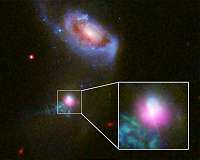
A team led by the University of Colorado Boulder has caught a supermassive black hole in a distant galaxy snacking on gas and then "burping" – not once, but twice.
CU Boulder Assistant Professor Julie Comerford, who led the study, said the supermassive black hole under study appears to have belched – essentially blasting out jets of bright light from the gas it inhaled – two times over the course of about 100,000 years.
While astronomers have predicted such objects can flicker on and off as a result of gas feeding events, this study is the strongest evidence that supermassive black holes do indeed switch on and off over timescales that are short compared to the age of the universe, which is 13.8 billion years old.
Supermassive black holes – which are millions of times heavier than our Sun and are believed to be at the heart of virtually every galaxy – are like regular black holes in basic ways: Regions with such strong gravitational effects that nothing, not even light, can escape. But when the areas around supermassive black holes emit light stemming from feeding episodes, they are known as quasars, said Comerford of CU Boulder's Department of Astrophysical and Planetary Sciences.
"We are seeing this object feast, burp and nap, and then feast, burp and nap once again, which theory had predicted," she said.
"Fortunately, we happened to observe this galaxy in a moment where we could clearly see evidence for both events."
A paper on the subject was published in a recent issue of The Astrophysical Journal. Comerford presented the team's findings in a Jan. 11 press briefing at the 231st meeting of the American Astronomical Society held Jan. 8-12 in Washington D.C.
The galaxy under study, called SDSS J1354+1327 (J1354 for short), is about 800 million light-years from Earth. For comparison, one light-year is roughly six trillion miles.
The team used observations from two space telescopes – NASA's Hubble Space Telescope and Chandra X-ray Observatory – as well as the W.M. Keck Observatory in Mauna Kea, Hawaii, and the Apache Point Observatory near Sunspot, New Mexico. The Apache Point facility is owned by the Astrophysical Research Consortium, a group of 10 U.S. research institutions that includes CU Boulder.
So why did the black hole have two separate meals? The answer lies in a companion galaxy that is linked to J1354 by streams of stars and gas due to a collision between the two galaxies, said Comerford. The team concluded that clumps of material from the companion galaxy swirled into the center of J1354 and then were eaten by the supermassive black hole.
Comerford said the team observed remnant emission extending 30,000 light-years south of the center of the galaxy that indicated there was a black hole feasting event roughly a billion years ago. To the north they saw emission located much closer to the black hole. This showed that a more recent burp occurred after a different clump of material had been consumed.
The Chandra observatory picked up large amounts of X-ray emissions from J1354, showing dust and gas were heated to millions of degrees as the material fell toward the center of the supermassive black hole. The X-ray spectrum shows the supermassive black hole lies within a heavy veil of dust and gas, said Comerford.
"This galaxy really caught us off guard," said CU Boulder doctoral student Rebecca Nevin, a study co-author who used data from Apache Point to look at the velocities and intensities of light from the gas and stars in J1354.
"We were able to show that the gas from the north part of the galaxy was consistent with an advancing edge of a shock wave, similar to a sonic boom, and the gas from the south was consistent with an older quasar outflow."
Even our Milky Way galaxy's supermassive black hole has had at least one burp, according to the team. In 2010 another research team discovered a Milky Way belch using observations from the orbiting Fermi Gamma-ray Observatory to look at the galaxy edge on. Astronomers saw gas outflows dubbed "Fermi bubbles" that shine in the gamma-ray and X-ray portions of the electromagnetic spectrum.
"These are the kinds of bubbles we see after a black hole feeding event," said study co-author Scott Barrows.
"Our galaxy's supermassive black hole is now napping after a big meal, just like J1354's black hole has in the past. So we also expect our massive black hole to feast again, just as J1354's has."
Black hole breakthrough: new insight into mysterious jets
Through first-of-their-kind supercomputer simulations, researchers, including a Northwestern University professor, have gained new insight into one of the most mysterious phenomena in modern astronomy: the behavior of relativistic jets that shoot from black holes, extending outward across millions of light years.
Advanced simulations created with one of the world's most powerful supercompu … read more
