
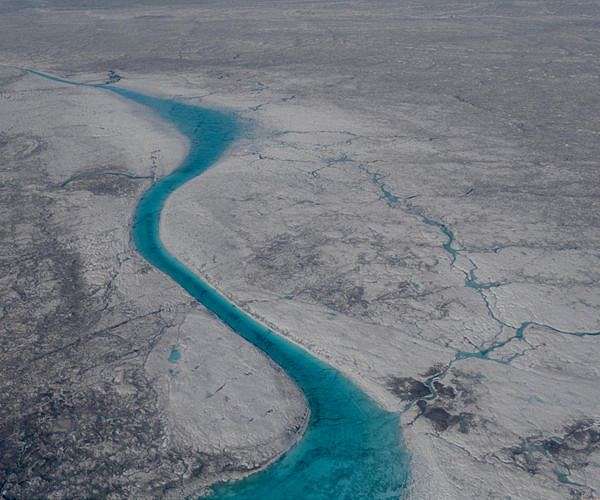
As the Arctic spring arrives earlier each year due to climate change, ice-dwelling algae are expanding their reach across Greenland's ice sheet, potentially accelerating its melt. These algae contain a brown pigment that darkens the ice, reducing its ability to reflect sunlight and thereby increasing melting rates.
Researchers have long known about this phenomenon, but it was assumed that the algae had limited colonization potential due to the scarcity of nutrients in the ice sheet's extreme environment. However, a new study published in *Nature Communications* reveals that these algae can survive on minimal nutrients and even store energy, allowing them to spread across the ice more extensively than previously believed.
Laura Halbach, who completed her Ph.D. at Aarhus University's Department of Environmental Science, led the study. Now a postdoctoral researcher at the Max Planck Institute in Bremen, she continues to explore Arctic ecosystems.
"My main goal with the trip to Greenland was to understand the mechanisms of the algae bloom formations. With new methods, I was able to, as the first researcher ever, measure the activity of single algae cells from the Greenland Ice Sheet. This led to the discovery of their ability to live off very few nutrients and to store up energy," she explained.
The Ice Sheet Teems with Microbial Life
Not long ago, scientists believed that the Greenland ice sheet was a barren, frozen wasteland. However, research by teams from Aarhus University and GFZ Helmholtz Center for Geosciences in Germany has changed that perception. Since their first expedition in 2020, scientists have uncovered a thriving ecosystem of bacteria, fungi, and even viruses living within the ice.
Despite these discoveries, studying the algae in isolation has been challenging. Typically, when researchers collect samples of darkened ice, they contain a mixture of different microorganisms, making it difficult to pinpoint the algae's role. Halbach sought to overcome this challenge by developing a novel approach.
"If you melt a piece of the surface ice, you see these dark pigmented algae. But there are many organisms in the sample, including snow algae, other eukaryotic algae, bacteria, and fungi. Traditionally, researchers incubate the entire community and measure nutrient uptake collectively, which makes it unclear what role each organism plays," Halbach noted.
Tracing Nutrient Uptake at the Cellular Level
To better understand the algae's role, Halbach and her team labeled nutrients with isotopic markers and introduced them into the ice sheet's microbial community. Using a highly sensitive mass spectrometer called SIMS, they tracked how different microorganisms absorbed the nutrients at a single-cell level.
"You could say that we kind of labeled the food we gave them. This enabled us to see who ate what. Combined with a machine called SIMS, which is extremely precise, we were able to measure the nutrient uptake of single cells," Halbach explained.
The results showed that ice algae efficiently absorb the scarce nutrients available-and that they can store phosphorus, an essential element for their metabolism. This ability allows them to survive and grow in nutrient-poor conditions.
Phosphorus is known to be rare on the ice sheet, with some studies suggesting it originates from local rocks that break down into mineral dust, which then gets distributed across the ice. The algae's ability to store this vital nutrient may enable them to expand into areas previously thought unsuitable for colonization.
Implications for Ice Sheet Melting and Climate Models
Because the Greenland ice sheet is losing its protective snow cover earlier each year, vast new areas of ice are being exposed to sunlight. This provides more habitat for the algae, which in turn increases the amount of darkened ice, further accelerating melting.
"New ice is being exposed on Greenland every year because the snow melts earlier and earlier. There used to be a thick snow cover all year round, but now large new areas of ice are being exposed to the sun," Halbach explained. "This opens up these areas for the algae to colonize, and as they can live on very limited amounts of nutrients, it might happen sooner than later."
The study's findings underscore the urgent need to incorporate microbial activity into climate models, which currently do not account for the impact of ice algae on melting rates. Integrating these biological processes could improve predictions of Greenland's ice loss and its contributions to rising global sea levels.
Research Report:Single-cell imaging reveals efficient nutrient uptake and growth of microalgae darkening the Greenland Ice Sheet
