
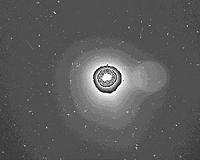
Less than a week before Rosetta's rendezvous with comet 67P/Churyumov-Gerasimenko, images obtained by OSIRIS, the spacecraft's onboard scientific imaging system, show clear signs of a coma surrounding the comet's nucleus.
A new image from July 25, 2014, clearly reveals an extended coma shrouding 67P's nucleus.
"Our coma images cover an area of 150 by 150 square kilometers (90 by 90 square miles)," said Luisa Lara from the Institute of Astrophysics in Andalusia, Spain. Most likely these images show only the inner part of the coma, where particle densities are highest. Scientist expect that 67P's full coma actually reaches much farther.
In the current image, the hazy, bright, circular structure to the right of the comet's nucleus is an artifact of the OSIRIS optical system. The center of the image located around the position of the nucleus is overexposed here.
Other new images of the comet's nucleus confirm the collar-like appearance of the neck region, which appears brighter than most parts of the comet's body and head. Possible explanations range from differences in material or grain size to topological effects.
