
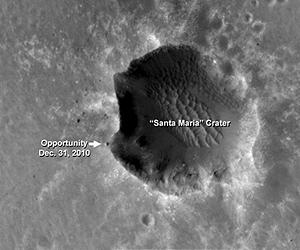
Opportunity is in position for solar conjunction at the southeast rim of the 80-meter (262-foot) diameter Santa Maria crater. Solar conjunction is the period when communications between Earth and Mars are disrupted because the Sun is directly in between the two planets.
The southeast region of the rim shows evidence for hydrated sulfate minerals. Opportunity is positioned near a bright surface target called "Luis de Torres," and has begun the planned in-situ (contact) surface science campaign that will continue through solar conjunction.
On Sol 2478 (Jan. 12, 2011), the rover performed a small ( approximately 4.6 degree) turn to position the surface target within reach of the rover's robotic arm (instrument deployment device, or IDD). The rover used the hazardous camera (Hazcam) to take some images of the arm's workspace.
A Deep Space Network issue delayed the return of data, so continued robotic arm activities had to wait. On Sol 2481 (Jan. 15, 2011), Opportunity used the IDD to collect a microscopic imager (MI) mosaic of the surface.
Then, the alpha particle X-ray spectrometer (APXS) was placed down for a multi-sol measurement. On Sol 2484 (Jan. 19, 2011), the APXS was lifted from the target and the rock abrasion tool (RAT) was positioned for a grind-scan in preparation for brushing the target on a subsequence sol.
Eventually the moessbauer spectrometer will be placed down for a multi-week integration.
As of Sol 2484 (Jan. 19, 2011), solar array energy production was 555 watt-hours with an elevated atmospheric opacity (Tau) of 0.789 and a solar array dust factor of 0.603.
Total odometry is 26,658.64 meters (26.66 kilometers, or 16.56 miles).
Share This Article With Planet Earth
