
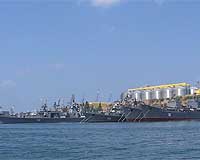
Russia is strengthening its forces in the south of the country, including its powerful Black Sea Fleet, Deputy Defense Minister Gen. Vladimir Popovkin announced Thursday.
Relations between Russia, the United States and NATO were tense for several months following the Russian invasion and occupation of one-third of the former Soviet republic of Georgia in the Caucasus last August.
Tensions have eased since President Barack Obama won the U.S. election on Nov. 4, but the powerful Russian Black Sea Fleet continues to closely monitor NATO warships and Western cargo ships bringing aid to Georgia.
According to a RIA Novosti report Thursday, Popovkin stated that the Russian Defense Ministry had carefully studied "the outcome of the South Ossetian conflict" and had concluded that it needs to boost military and naval forces in the region. Russia is also locked in a series of disputes with neighboring Ukraine, the most populous of the former Soviet republics, apart from Russia.
Accordingly, Popovkin announced that Russian ground forces in the South henceforth would be equipped with new multiple rocket launching systems and more effective reconnaissance tools.
Since the Battle of Stalingrad in 1942, Russia's multiple rocket launching systems have been among the most powerful, advanced and effective heavy artillery in the world. The Russian armed forces are also following the U.S. lead by investing heavily in unmanned aerial surveillance aircraft to target their artillery and tactical short-range rockets more effectively.
RIA Novosti quoted Popovkin as saying that other measures to strengthen military forces in southern Russia would include upgrading Mikoyan-Gurevich MiG-29 Fulcrum fighters and Sukhoi Su-25 Frogfoot ground attack planes, as well as Mi-28H Night Hunger helicopter gunships. The forces also would be supplied with new aircraft such as the Su-27SM, the Sukhoi Su-30MK-2 and combat helicopters such as the Kamov Ka-52, the Mi-28N, the Mi-24M and the Mi-8MTB5, he said.
Air Defense Forces in the region are to be provided with modern Pantsir-S surface-to-air missile systems, the general said.
The Black Sea Fleet will be expanded by the addition of new Lada Project 677 diesel-electric submarines, modernized versions of the Varshavyanka-class submarine, and Bal-U mobile coastal missile systems, RIA Novosti said.
Russia denied claims in February that the Black Sea Fleet had been mobilized and was prepared for naval operations. The fleet still operates out of several bases in the Crimea, which is part of Ukraine, under a 1997 arrangement whereby Ukraine leased the bases to Russia for 20 years until 2017.
However, pro-Western Ukrainian President Viktor Yushchenko said last summer he was not prepared to renew that agreement beyond 2017 and said he wanted Russia to get ready to abandon its bases.
In response, the Russian media have carried reports, monitored in these columns, that Russia might respond to the loss of Sevastopol and other Crimean bases by establishing permanent bases in such friendly countries as Yemen, Syria and Libya instead.
