
A top US military officer said Wednesday that Russia is "probably" violating the Comprehensive Nuclear-Test-Ban Treaty, opening a new area of disagreement as the two powers negotiate arms control.
Lieutenant General Robert Ashley, director of the Defense Intelligence Agency, part of the US military that provides analysis, voiced alarm at Russia's modernization of its nuclear forces.
"The United States believes that Russia probably is not adhering to the nuclear testing moratorium in a manner consistent with the zero-yield standard," Ashley said in a speech at the Hudson Institute, a think tank.
"Our understanding of nuclear weapon development leads us to believe that Russia's testing activities would help it improve its nuclear weapons capabilities," he said, adding that the United States by contrast has strictly adhered to the ban.
Pressed by a reporter to explain Russia's alleged wrongdoing, Ashley appeared to retreat from the charge that Moscow had actually carried out tests in violation.
"I'd say we believe they have the capability to do it, the way they're set up," he said.
The Comprehensive Test-Ban Treaty, which was adopted by the UN General Assembly in 1996, bans all nuclear tests worldwide whether for civilian or military purposes.
It has generally been interpreted as barring all levels of testing, even highly technical, small-scale tests with minimal yields.
The United States has in the past confirmed that Russia is in compliance with the treaty, which Moscow has signed and ratified.
The US has signed the treaty but its ratification was rejected in 1999 by the Senate due to opposition from Republicans.
Conservative Republicans — notably John Bolton, now President Donald Trump's national security advisor — oppose the treaty on the grounds that it is unenforceable and impedes US sovereignty.
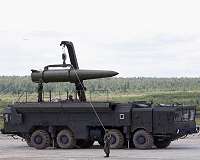
The Trump administration earlier this year moved to exit another major treaty, the Intermediate-Range Nuclear Forces Treaty, after saying that a new Russian missile system was in violation, a finding shared by NATO allies.
The two countries have begun initial discussions on extending the New START treaty, which caps the number of nuclear warheads well below Cold War limits and is set to expire in 2021.
The Trump administration wants to bring China into the treaty, an idea already rejected by Beijing — whose arsenal is rapidly growing but remains a distant third in size.
Pentagon chief in Asia for 'candid' talks on China expansion
Jakarta (AFP) May 29, 2019 –
Pentagon chief Patrick Shanahan kicked off a week-long Asian tour Wednesday with an eye to strengthening ties with regional allies and having "candid" talks with his Chinese counterpart on Beijing's growing might.
"It's more about listening and being able to hear from the allies and partners," the acting US defence secretary said in a plane bound for Jakarta.
Indonesia is the first leg of a tour that also includes stops in Singapore, South Korea and Japan.
On Thursday, Shanahan will meet with Indonesian President Joko Widodo after talks with Foreign Minister Retno Marsudi and Defence Minister Ryamizard Ryacudu.
Cooperation on maritime issues with the sprawling Southeast Asian archipelago nation will be at the top of the agenda, as the US looks to offset China's expanding presence in the South China Sea.
In Singapore on Saturday, Shanahan is to meet Chinese Defence Minister Wei Fenghe on the sidelines of the Shangri-La Dialogue regional defence forum.
"I want to identify areas where we can cooperate," Shanahan told reporters accompanying him on the trip, adding that he hoped to have "very candid discussions around intellectual property theft, or militarisation of the South China Sea."
Washington has repeatedly called for "freedom of navigation" in the busy maritime channel as Beijing builds up its military capabilities, while China has accused US ships of breaching its territorial waters.
But Shanahan said rising tensions would not prevent the US from pushing forward with a defence strategy that sees China and Russia as Washington's main rivals.
"We have the capacity to spin a lot of plates," he added.
Washington has deployed some 1,500 troops, an aircraft carrier, a warship, B-52 bombers and a Patriot missile battery in the Middle East, citing "threats" from Iran or pro-government militias toward its interests and troops in that region.
