
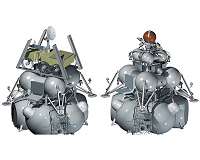
Russia's space agency said that Roscosmos does not intend to abandon the implementation of the Luna-Grunt (Lunar Sample-Return) project aimed at delivering lunar soil to the Earth. Roscosmos does not intend to abandon the implementation of the Luna-Grunt (Lunar Sample-Return) project aimed at delivering lunar soil to the Earth, Russia's space agency said on Tuesday.
"Work on the lunar program, planned in the framework of the Federal Space Program for 2016-2025 years, will be implemented according to the plans. In particular, the contract for the development of the technical specification of the Luna-Grunt mission has been signed and will be implemented," the agency's spokesperson said. Earlier in the day, the scientific director of the Institute of Astronomy, Boris Shustov, said that Russia had abandoned the project, and of the five spacecraft intended to study the moon, only four were expected to be launched.
Firm: Russia to Shift All Lunar Launches to Vostochny Cosmodrome
Russia will stop using the Soviet-era Baikonur cosmodrome in Kazakhstan for lunar launches, according to Russian-based Rocket and Space Corporation (RSC Energia).
Moscow made the decision to shift all operations linked to Russia's moon mission to the Vostochny cosmodrome, the company behind the program said.
"All further works to implement the lunar program, including a flight around the moon and a moon landing will take place after 2025. All launches will take place at the Vostochny cosmodrome," RSC Energia General Designer Yevgeny Mikrin said.
Vostochny in Russia's Far East was conceived as an alternative to Baikonur, which is on lease to Russia until 2050. The new space port has been under construction since 2012. The first launch from Vostochny is planned for April 27, according to the Russian Space Agency Roscosmos.
Russia is already building a next-generation reusable spacecraft to replace the Soyuz family. The spaceship, called Federation, is due to be launched in unmanned mode in 2021, with a manned launch to the International Space Station planned by 2023, Mikrin said at the company's council meeting in the city of Korolyov near Moscow.
Mikrin said the Energia corporation was also working on a range of space technologies that would further the ambitious lunar program, including a heavy-lift launch vehicle, an upper-stage rocket and an interorbital space tug.
