
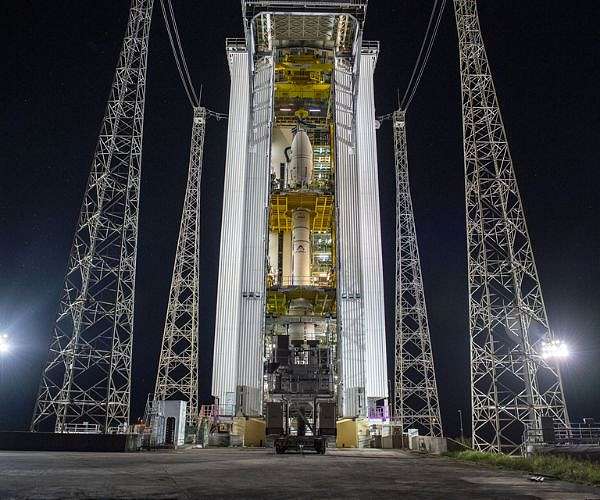
In preparation for liftoff on 4 September 2024 (3 September Kourou time), the Vega-Sentinel-2C upper-composite has been hoisted into the launch tower at Europe's Spaceport.
The Sentinel-2 mission consists of a pair of identical satellites, Sentinel-2A, launched in 2015, and Sentinel-2B, launched in 2017. These satellites operate in the same orbit, positioned 180 apart to maximize coverage and reduce revisit times.
Each satellite is equipped with a high-resolution multispectral imager that captures optical images across the visible to shortwave-infrared spectrum. Operating from an altitude of 786 km, they capture data in 13 spectral bands at resolutions of 10, 20, and 60 meters, covering a wide swath of 290 km.
The data collected by the Sentinel-2 satellites support various applications, including precision agriculture, water quality assessment, natural disaster response, and methane emission monitoring.
Sentinel-2C is set to launch aboard Vega, Europe's dedicated rocket for small scientific and Earth observation missions. Vega specializes in placing payloads into sun-synchronous polar orbits, tracking the Sun.
Standing at 30 meters tall, Vega weighs 137 tonnes on the launch pad. It utilizes three solid-propellant stages, followed by a liquid-propellant fourth stage, to precisely position Sentinel-2C in orbit. Despite its relatively lightweight, Vega's powerful propulsion ensures the satellite reaches space within just seven minutes after launch.
Upon reaching orbit, Sentinel-2C will take over operations from its predecessor, Sentinel-2A, with Sentinel-2D slated to eventually replace Sentinel-2B.
