
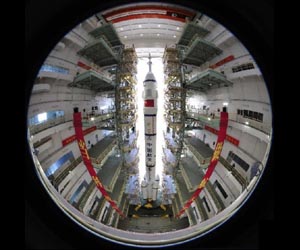
China's next astronaut mission, Shenzhou 10, is due to launch soon. Wang Yaping, China's second female astronaut, will be aboard. Two other astronauts will join her. The Shenzhou will dock with the Tiangong 1 space laboratory for around 12 days. Total mission time will be around 15 days. There will be a flyaround of Tiangong and docking tests with different approach profiles. Television will be shown from inside Tiangong.
That's about all China's state-run media want us to know about the upcoming mission. It is probably due to lift off in less than seven days, but we do not know the exact date or time yet.
It's typical for Chinese authorities to trickle information sparingly about their space launches, but this time, the trickle is even smaller than ever.
China's state-run media now seem to be operating under a Code of Silence that's less like the typical editorial policies forged by the Chinese government and more like the policies of a well-known Sicilian fraternal organization.
Chinese state media used to construct special sections of their Web sites dedicated to important space missions. They would be stocked with news archives, images, multimedia and fact sheets. Banners linking to these sections would feature prominently on the home pages of these news sites. If you read the Chinese press, you couldn't ignore the fact that China was about to take another major step forward in their space program.
At the time of writing, no such coverage had been observed on the Web. Given the apparent proximity of the launch, special sites should have already been constructed.
We should have expected some "soft" news, profiles or background pieces on China's space activities. These always help to put new missions in context. Again, they seem to be lacking.
If the Chinese media won't "sing" for us, there are other ways of finding out what's happening. Space analysts have been speculating on mission outcomes for some time. The launch site can be observed with satellite imagery for clues, although the Long March 2F rocket has already been sent to the Launchpad. The orbit of Tiangong 1 is closely monitored.
This unusually sparse pattern of media relations on the Shenzhou 10 mission has been apparent for a few weeks. This analyst hoped that media coverage in China would be ramped up in the week before the launch, but so far, we can see no strong evidence of this.
The lack of coverage diminishes the recognition and respect that China deserves for its advanced space program. While some aspects of the technology are sensitive, the program as a whole could be publicized more without compromising any real secrets.
Exactly why an even stronger "omerta" code has been introduced for Shenzhou 10 is not entirely clear at this stage. It is probably linked to politics and bureaucracy, which have been influenced by China's recent change of leadership. Alternatively, it could point to some issues inside the space program that are even more opaque to external observers. For the moment, all we can do is speculate.
