
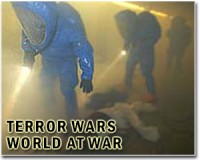
Sirens wailed across Israel on Tuesday, sending many into shelters as part of the largest-ever exercise to test the response to a "doomsday" mix of missile attacks, suicide bombings and natural disasters.
Israelis throughout the country were asked to head to shelters when they heard the sirens, with radio and television underlining that it was only as part of an exercise.
"The purpose of the siren is to affect the consciousness of the Israeli public," Deputy Defence Minister Matan Vilnai said. "Every citizen of the state should know that an emergency drill can take place anytime anywhere, and how they should act.
Schoolchildren, government workers and shoppers at malls headed to basements when the alerts screeched across the country as part of a five-day exercise that simulates responses to rocket strikes from the Gaza Strip and Lebanon and missile attacks from arch-foes Syria and Iran.
Many, however, seemed indifferent.
"We've just ordered food," said Vered, 39, whose salad and orange juice arrived at a cafe inside the Dizengoff Centre shopping mall in Tel Aviv, where nearly all those with seats stayed put.
"It's not that we don't think it matters," she said. "Had we known we wouldn't have ordered. It's important. But not so important that we'd leave our food."
Exercise Turning Point 3 is also aimed at simulating the conduct of rescue and medical services during earthquakes and epidemics and involves the participation of schools, government ministers and other state institutions.
At the Mitzpe Golan school in Bnei Yehuda on the Golan Heights, children lined up in a more or less orderly fashion to enter shuttered classrooms as the sirens began wailing.
"This kind of exercise is particularly relevant in the Golan as the danger is real," one teacher said as the children clapped and sang a song.
The area was among those the came under Hezbollah rocket fire during the July-August 2006 war between Lebanon's Shiite militia and Israel.
Israel began conducting its emergency services drills annually in the aftermath of the war, which revealed major weaknesses in how the Jewish state's homefront dealt with the rocket attacks.
This year's drill was the largest held in the three years since the war.
It comes just two weeks after the air force wrapped up a massive four-day exercise that tested its ability to defend against missile and jet strikes from Syria and Iran.
It was the first time the army has simulated strikes from arch-foe Iran, located more than 1,000 kilometres (620 miles) away.
Share This Article With Planet Earth
