
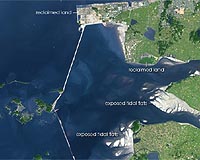
South Korea on Tuesday announced an amended 18.9 trillion won (14.2 billion dollar) plan for developing a vast wetland area on its southwest coast, fuelling fears of environmental damage.
The tidal area around Saemangeum estuary was dammed in 2006 following a long fight between the government and environmentalists, who said the reclamation project would deprive migratory birds of a key habitat and pose water pollution risks.
A new plan approved by the cabinet will see more of the reclamation developed and less used for farmland than was originally envisaged. It is also twice as expensive as the original plan.
The new plan calls for 30 percent of the 18,410 hectare (45,473 acre) site to be used for non-agricultural purposes, 39 percent for farming and the rest unspecified to provide flexibility in the future.
The old plan would have seen development of 70 percent of the land for farming. Agriculture in South Korea has become less competitive in recent years because of the small amount of available arable land and high production costs.
The new plan envisions a two-stage approach that would permit the building of factories, power plants, tourism and resort zones by 2020.
A further 9,890 hectares of reclaimed land will be developed from 2021.
Of the total budget, 12.1 trillion won will be used to prepare land, 4.4 trillion for building infrastructure such as roads, railways and port facilities, and 2.4 trillion won for environmental projects.
Lee Bong-Ho, head of the agriculture ministry's farmland development division, said 7.8 trillion won would come from the central government, 10.6 trillion won from the private sector and 500 billion from local government.
Saemangeum estuary sits at the mouths of two rivers, the Mangyeong and Dongjin. The completion of the 33-kilometre (21 mile) seawall in April 2006 has interrupted the flows of the rivers, which critics say has increased pollution risks.
Activists charge the amended project is worse than the original.
"The central government and the provincial governments have spent a lot of tax money for purifying the two rivers but there is no sign of any progress," the Korean Federation for Environmental Movement said in a statement.
"Under these circumstances, water pollution will only get worse if industrial facilities and commuter towns, instead of farmland, pop up on a large scale."
