
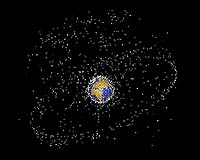
The spacefaring nations of the world are coming to the conclusion that the space debris issue has evolved from a minor nuisance to a full-blown imperative. Hundreds, if not thousands, of decision makers, engineers, managers, politicians and policy makers have focused their attention on how to deal with the fast-growing threat to operational satellites and future access to space.
All that use space and take advantage of space applications will be affected by the actions of these people in the coming years. There is little doubt that we must move from a reactive mode to a proactive mode when dealing with space debris remediation.
It is clear that methods and systems for reducing the debris threat will be developed over the next several years. This will be followed by a period of orbital operations that will slowly reduce collision-damage probabilities to some universally accepted set of values.
The solution will involve several ground-based and space-based activities, including added spacecraft shielding, extra satellite onboard propellant for maneuvering, limitations on creating new debris, automated de-orbiting of upper stages, mandatory end-of-life risk-reduction maneuvers and physical removal of debris from high-threat zones. Success will require all spacefaring nations to cooperate and work together.
Once we bring the space debris issue under control, what next? If we are to continue to utilize space and maintain safety for operational satellites, there must be an ongoing international program to keep debris-collision risks at acceptable levels.
This program may be called "Space Traffic Management" and might operate on a voluntary basis in which spacefaring nations agree to limitations on populating certain orbital slots or zones. Each nation would furthermore have to accept the liability associated with the creation of new debris and agree to certain restrictions on orbital usage.
Space traffic management would also entail the continued control of debris through an active removal program that maintains the highly-used orbital regions safe for operation satellites.
Ultimately, the space traffic management program may be integrated with the main-stream space program in a way that would permit new spacecraft orbit insertions and debris removal operations with every launch campaign.
This approach may lead to optimization of the cost and complexity of debris control while "closing the loop" on space utilization. Let's save space for future generations!
Share This Article With Planet Earth
