
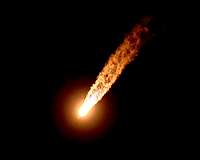
The secondary cargo from the recent Falcon 9 remained undisclosed until US military published orbital data from the launch, where the second object suddenly appeared. A company, related to the launch, claims the cargo is for a R and D mission.
The celebratory 50th launch of SpaceX's Falcon 9 rocket was supposed to be a regular satellite delivery for Hispasat, a Spanish-language communications operator.
However, the orbital data, published by the US military shows that a secondary payload, named PODSat, separated from the Hispasat 30W-6 satellite, when the latter reached orbit.
The niche web portal Spaceflightnow.com reports officials from Space Systems/Loral (SSL) and NovaWurks, two companies involved in the launch, have only acknowledged the existence of a secondary payload release system.
According to Wendy Lewis, a spokesperson for SSL, "An innovative secondary payload release system was successfully tested on Hispasat 30W-6. This was an R and D mission not related to the ongoing operation of the Hispasat satellite. Ride-share arrangements such as this are becoming more common as they help defray the cost of launch and drive innovation for our industry."
Lewis added "we are not disclosing further details about the secondary payload at this time but we are optimistic about its potential as part of the SSL future R and D roadmap."
According to the Spaceflightnow.com report, James Greer, chief operating officer at NovaWurks, also refused to elaborate on the secondary satellite's mission, noting that he couldn't do it as it was a "DARPA [US Defense Advanced Research Projects Agency] project."
NovaWurks, using the DARPA funding, developed a Hyper-Integrated Satlet, or HISat, architecture, which can be used to reduce satellite construction and deployment costs.
SSL in its turn developed a Payload Orbital Delivery System, or PODS, a mechanism attached to the Hispasat 30W-6 satellite that was used to release the secondary satellite, once primary payload reached its orbit.
