
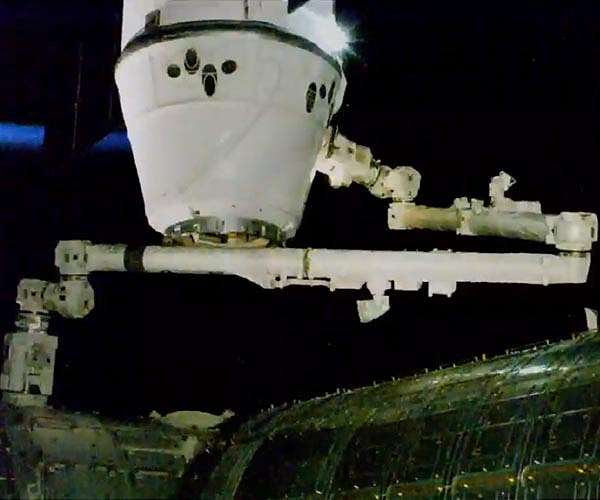
A SpaceX Dragon cargo capsule docked at the International Space Station on Monday with science materials, the first privately owned airlock and a holiday meal.
The docking marked the first time in history that two privately owned spacecraft have been attached to the space station. The cargo vessel joined Resilience, SpaceX's Crew Dragon craft that brought four astronauts to the station on Nov. 16.
The capsule first connected with the space station at 1:40 p.m. EST, 268 miles over the southern Indian Ocean, according to NASA.
"A great view of cargo Dragon now in its new home," a NASA public information officer said as a live feed showed the spacecraft.
Other projects on board the mission, SpaceX CRS-21, include research on vaccines and on microbes that could be used to break down rocky material on asteroids; a tool being tested for quick blood analysis in microgravity; and another human tissue study regarding the effects of spaceflight on post-traumatic osteoarthritis and bone loss.
For the upcoming holidays, NASA has sent roasted turkey, cornbread dressing, jellied cranberry sauce, shortbread cookies and decorative sparkle gel, among other fixings.
The experiments are part of NASA's goal to accelerate science on the space station as it hosts seven people, the most in years.
The mission, which launched Sunday morning from Florida, also marks the first flight for SpaceX's upgraded cargo Dragon 2 capsule.
"It's a really big vehicle and takes a lot of cargo up. It has 20 percent more volume than the previous version," Sarah Walker, SpaceX director of Dragon mission management, said at a press conference Friday.
The goal of the heart experiment is to determine how heart tissue changes in microgravity. Scientists at Stanford University in California believe the tissue will show signs of atrophy, or weakening, lead researcher Joseph Wu said.
Under the capsule, in SpaceX's storage trunk, NASA and Pittsburgh-based space company Nanoracks plan to ferry the company's Bishop Airlock to the space station. Astronauts plan to install the airlock on the exterior of the space station, where it will release science experiments and small satellites into space.
Having a private airlock just for science experiments and small satellites will allow more efficient use of the station's airlocks and allow for more commercial activity, according to NASA.
Nanoracks funded the construction of the airlock, which cost about $15 million, for the opportunity to have private enterprise utilize it, according to the company. NASA signed an agreement with the company for the idea.
