
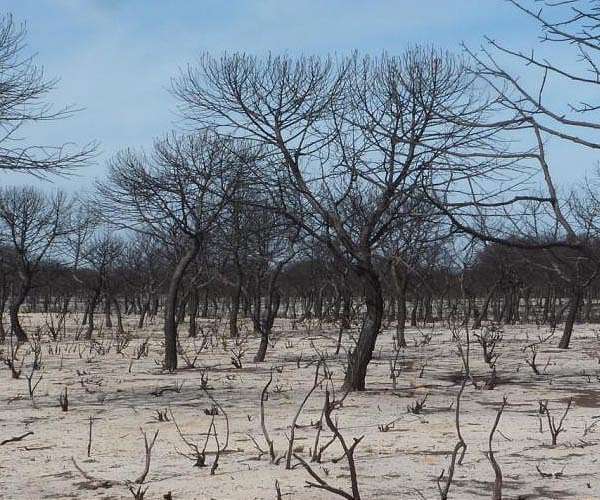
Emergency services battled several wildfires Sunday in northern Spain as an unseasonable heatwave that gripped the country for the past week finally eased.
The most alarming blaze in the northwestern Sierra de Culebra mountain range has already destroyed over 25,000 hectares (62,000 acres), the regional government said.
It started on Wednesday during a dry thunderstorm but firefighters said cooler overnight temperatures had helped them make gains in their battle against the flames.
Residents of some 20 villages who were evacuated from their homes were allowed to return home Sunday morning due to the improved situation, local officials said.
Several roads reopened and a high-speed rail link between Madrid and the northwestern region of Galicia, which was closed Saturday due to the blaze, reopened, they added.
Elsewhere in Spain, smaller wildfires were also raging in the northwestern region of Catalonia and the northern Navarra region, one of the few areas of Spain where temperatures remained unusually high Sunday.
The regional government of Navarra urged residents to avoid "unnecessary travel" to keep roads free for fire crews.
"We have a very difficult few hours ahead of us," the director of Navarra's interior ministry, Amparo Lopez Antelo, told reporters.
The battle against the blaze was hindered by high temperatures and southerly wind gusts of over 30 kilometres (18 miles) an hour, she added.
Temperatures of more than 40 degrees Celsius (104 degrees Fahrenheit) have been recorded in many cities and other areas throughout the week but they dropped Sunday in most of the country.
The mercury was only expected to hit 29 degrees Celsius in Madrid on Sunday and 25 degrees in the province of Zamora where the Sierra de Culebra mountain range is located.
Europe swelters in record-breaking June heatwave
Paris (AFP) June 19, 2022 –
Spain, France and other western European nations sweltered over the weekend under a blistering June heatwave, with some wildfires still blazing even as the weather began to ease.
The soaring temperatures were in line with scientists' predictions that such phenomena will now strike earlier in the year thanks to global warming.
Emergency services battled several wildfires Sunday in northern Spain. The most alarming blaze in the north-western Sierra de Culebra mountain range has destroyed more than 25,000 hectares (62,000 acres), the regional government said.
Firefighters said cooler temperatures overnight had helped them make progress in their battle against the flames.
Residents of some 20 villages evacuated from their homes were allowed to return home Sunday morning, local officials said.
Temperatures of more than 40 degrees Celsius (104 degrees Fahrenheit) have been recorded in parts of Spain throughout the week, but they had dipped by Sunday in most of the country.
The mercury was only expected to hit 29C in Madrid on Sunday and 25C in the province of Zamora where the Sierra de Culebra mountain range is located.
There have also been fires in Germany, where temperatures reached 38C in the eastern regions of Brandenburg, Thuringia and Saxony with the eastern city of Cottbus setting a new German record for June of 38.7C.
One fire in the Brandenburg region outside Berlin saw 700 people evacuated, local authorities said, as the blaze threatened "three quarters" of the town of Treuenbrietzen.
In contrast, several northern regions were shivering in temperatures of 12C.
Austria's western Vorarlberg region hit a seasonal record of 36.5C at Feldkirch on the Swiss border, with the country's ZAMG meteorological institute indicating this June has already seen twice as many days surpassing 30C as normal.
Much of neighbouring Switzerland was also labouring under a heatwave with meteorological authorities indicating Sunday would see more records broken after a slew of hitherto unseen seasonal peaks the previous day.
As Geneva sweltered under 35C, several other towns were not far behind, Neuchatel and Fahy beating previous records topping 34C.
In southern France, a blaze triggered by the firing of an artillery shell in military training burnt around 200 hectares of vegetation, authorities in the Var region said.
"There is no threat to anyone except 2,500 sheep who are being evacuated and taken to safety," the local fire brigade chief said.
– Record temperatures –
The popular French southwestern seaside resort of Biarritz saw its highest all-time temperature Saturday afternoon of 42.9C, state forecaster Meteo France said as authorities urged caution from the central western coast down to the Spanish border.
Many parts of the region surpassed 40C, although storms were expected on the Atlantic coast on Sunday evening.
With the River Seine off limits to bathing, scorched Parisians took refuge in the city's fountains.
And at Vincennes Zoo on the outskirts of the capital, shaggy-haired lions licked at frozen blood fed to them by zookeepers, who monitored the enclosure's animals for signs of dehydration.
"This is the earliest heatwave ever recorded in France" since 1947, said Matthieu Sorel, a climatologist at Meteo France calling the weather a "marker of climate change".
– Foretaste of future –
The UK recorded its hottest day of the year on Friday, with early afternoon temperatures reaching over 30C.
Several towns in northern Italy announced water rationing. The country's dairy cows were putting out 10 percent less milk as a result of the heat, the main agricultural association Coldiretti said Saturday.
Experts warned the high temperatures were caused by worrying climate change trends.
"As a result of climate change, heatwaves are starting earlier," said Clare Nullis, a spokeswoman for the World Meteorological Organization in Geneva.
"What we're witnessing today is unfortunately a foretaste of the future."
