
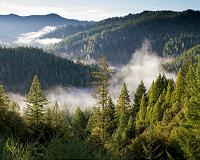
Every year the forest gets farther away. According to researchers at the SUNY College of Environmental Science and Forestry, between 1990 and 2000, the average distance between any point the United States and the nearest forest grew by a third of a mile — 14 percent.
Surprisingly, the survey — detailed in the journal PLOS ONE — showed rural forests and forests on public lands were most vulnerable.
"The public perceives the urbanized and private lands as more vulnerable, but that's not what our study showed," Giorgos Mountrakis, an associate professor at ESF in Syracuse, N.Y., said in a news release. "Rural areas are at a higher risk of losing these forested patches."
From an ecological perspective, small and isolated patches of forest are extremely valuable.
"You can think of the forests as little islands that the birds are hopping from one to the next," Mountrakis said.
Urban forests tend to earn more public attention, which means they're often better protected by local citizens, legislators and policy makers.
The analysis of Mountrakis and his colleagues showed forests in the Western United States are also more vulnerable than those on the East Coast.
"So if you are in the Western U.S. or you are in a rural area or you are in land owned by a public entity, it could be federal, state or local, your distance to the forest is increasing much faster than the other areas," Mountrakis said. "The forests are getting further away from you."
Mountrakis hope the study will inspire further analysis of the drivers of forest losses in the United States.
Myanmar makes record seizures of illegal timber
Myanmar seized a record amount of illegal timber this financial year as part of a government clampdown to protect the country's rapidly disappearing forests, a senior official said on Wednesday.
Forest ministry director Tin Tun said authorities had confiscated 40,000 tonnes of timber since April 2016, months before the newly elected government issued a nationwide ban on logging.
"There h … read more
