
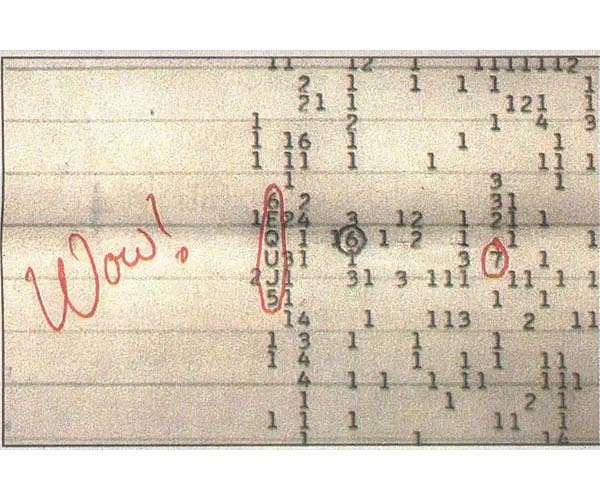
On May 6, the International Journal of Astrobiology of Cambridge University Press published a paper titled 'An approximation to determine the source of the Wow! Signal', authored by Alberto Caballero, a Spanish astronomer and science communicator.
Caballero decided to search through a catalog of stars from the European Space Agency's Gaia satellite to look for possible candidates.
He identified a Sun-like star designated 2MASS 19281982-2640123, about 1,800 light-years away, that has a temperature, diameter and luminosity almost identical to the Sun.
The Wow! Signal most likely came from some kind of natural event and not aliens, Caballero told Live Science, although astronomers have ruled out a few possible origins like a passing comet.
While living organisms may exist in a wide variety of environments around stars different to our own, he chose to focus on sun-like stars because "as with the search for planets in the habitable zone, we're looking for life as we know it; it could be a good idea to search for habitable planets and technosignatures around this sun-like star".
Caballero, a Scottish-born who studied Criminology at the Spanish university of Santiago de Compostela, already became interested in astronomy at a young age, and in 2019 he started coordinating more than 30 astronomical observatories world-wide under the Habitable Exoplanet Hunting Project.
What is the Wow! Signal?
The prominent and still-mysterious Wow! Signal, which briefly blared in a radio telescope the night of Aug. 15, 1977, remains a mystery until today.
"The Wow! Signal is considered the best SETI candidate radio signal that we have picked up with our telescopes due to its large duration in the hydrogen line," Caballero told Live Science.
SETI, or the search for extraterrestrial intelligence, is a field that has been listening for possible messages from extraterrestrial civilizations since the middle of the 20th century, according to NASA.
Appearing during a SETI search at the Ohio State University's Big Ear telescope, the Wow! Signal was incredibly strong but very brief, lasting a mere 1 minute and 12 seconds, according to a report written by its discoverer, astronomer Jerry Ehman.
"Since hydrogen is the most abundant element in the universe, there is good logic in guessing that an intelligent civilization within our Milky Way galaxy desirous of attracting attention to itself might broadcast a strong narrowband beacon signal at or near the frequency of the neutral hydrogen line," Ehman wrote in his anniversary report.
Researchers have since repeatedly searched for follow-ups originating from the same place, but they have turned up empty, according to a history from the American Astronomical Society.
